
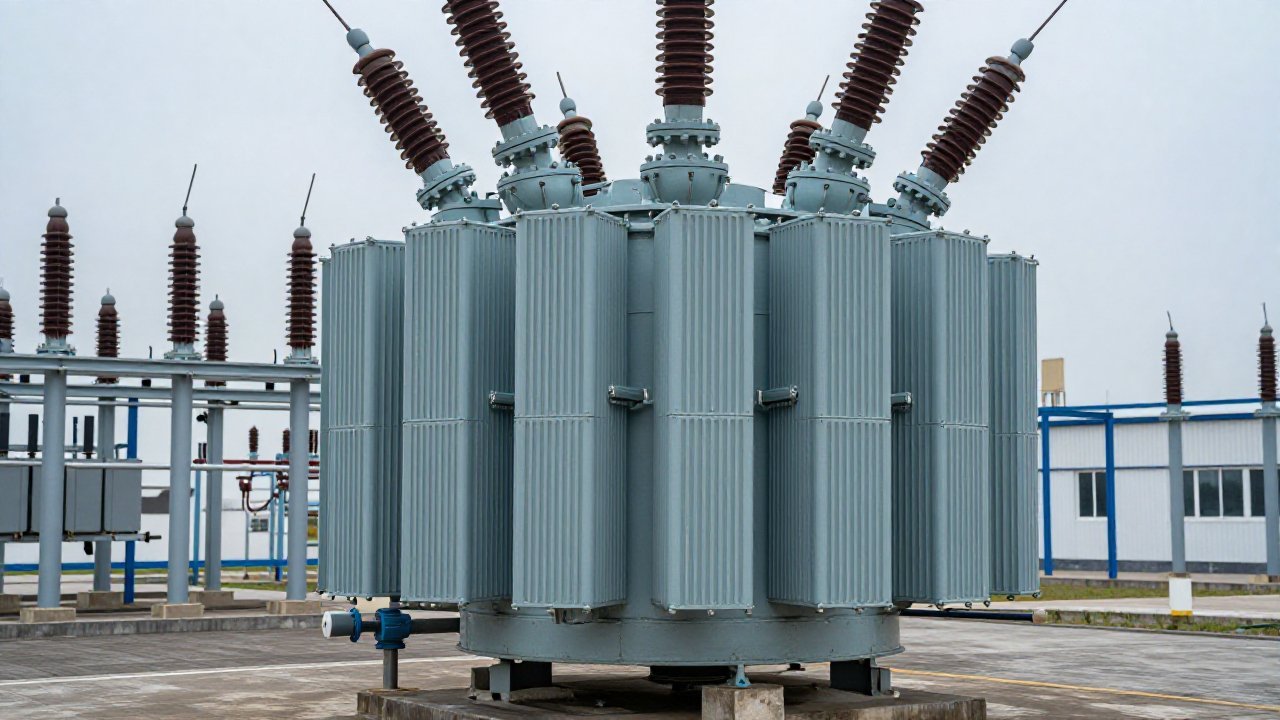
IEC published Edition 5.0 of IEC 60422 on 18 July 2024, replacing the 2013 edition as the reference for supervising mineral insulating oil in transformers and switchgear. Almost every practical question about transformer oil test frequency ends at its Table 4 — and most operators quoting it have never read the scope paragraph above.
What IEC 60422 is, and what it is not
It is a supervision guide for mineral insulating oils to IEC 60296: which properties to measure, the limit values that say the oil is still fit for service, and how often to sample.
Its scope then draws a line that matters more than any limit value: IEC 60422:2024 does not cover condition monitoring of the equipment itself, and names the exclusions — dissolved gas analysis, furanic compounds, or other means. DGA belongs to a different standard, and therefore to a different schedule.
What the schedule contains, and how often it repeats
Table 4 is built around a routine test group that examines the oil as a material. Every row below is a property of the oil, not a measurement of the fault.
| Routine test | Reads | What it detects |
|---|---|---|
| Appearance and colour | Visual, colour number | Free water, sediment, the earliest cheap signal of change |
| Breakdown voltage | kV across an oil gap | Water and particulate contamination |
| Water content | mg/kg | The ageing driver, and bubble risk at operating temperature |
| Acidity | mg KOH/g | Oxidation products, paper degradation |
| Dissipation factor, resistivity | Dimensionless / ohm·metre | Polar contaminants, ageing by-products |
| Inhibitor content, where added | % of added antioxidant | Remaining oxidation reserve |
None of these rows measures a gas. An oil can pass all six and still sit on a developing hot spot, because the evidence is dissolved in it as hydrogen and hydrocarbon fragments this group never looks for.
Intervals are set by equipment category — power transformers above 170 kV, the 72.5–170 kV band, units at or below 72.5 kV, then instrument transformers, tap-changer compartments, switchgear and bushings — and shortened when the oil reads fair or poor. Independent summaries report the bands as roughly 1–2, 1–3, 1–4 and 2–6 years depending on category and duty (BAUR GmbH, vendor summary); a published summary of BS EN IEC 60422:2024 puts the largest category at 1–2 years and the lowest-risk one at up to 12. Table 4 itself is authoritative.
The shape of the answer is what matters: transformer oil test frequency is measured in years — right for oil degradation, wrong for a fault. A hot spot can raise hydrogen measurably inside a day, and a flashover path can form in less, entirely between two scheduled samples.
FAQ: How often should transformer oil be tested?
Any answer to the transformer oil test frequency question depends on equipment category, voltage class and load. Under IEC 60422:2024 the routine group runs as short as about once a year for the largest, most heavily stressed transformers and stretches to several years for small, lightly loaded units in good condition. Use Table 4 as the reference and your own history as the tie-breaker.
FAQ: Does IEC 60422 cover dissolved gas analysis?
No, and by its own wording. DGA is excluded from the scope of IEC 60422:2024, which addresses the oil rather than the equipment. Gas interpretation is IEC 60599, gas-in-oil sampling IEC 60567, and the measurements sit with the laboratory gas standards. A plan that says “we follow IEC 60422” is a plan for the oil, not a fault-monitoring plan.
Where the schedule stops and monitoring starts
The two activities do not compete. The oil tests tell you whether the insulation is degrading — slow, cheap, worth keeping on schedule. Gas monitoring answers a different question, whether something new is happening inside, and wants a different clock. Hydrogen is the practical marker: the first gas many faults produce, common to thermal, discharge and arcing regimes, and fast enough to watch continuously (why hydrogen first).
The industry is converging on this pairing: IEEE PES T&D 2026 in Chicago (4–7 May) grouped lifecycle asset management with hybrid condition monitoring, and DNV's Transformatordag (Doorwerth, 17 September 2026) lists a probe reading breakdown voltage and dissolved gases from one fitting.
A continuous channel at the drain valve does not replace the scheduled sample — moisture and acidity still come from the laboratory — but it closes the window a fault has to grow in. The hydrogen sensor range measures dissolved hydrogen in situ and reports a trend, and the compliance guide sets out how that channel sits beside the laboratory schedule rather than on top of it. The sampling procedure and moisture picture belong in the same plan, and routine oil testing remains the floor, not the ceiling.
Ask us how a continuous hydrogen channel fits your existing oil test schedule.
Sources
- IEC 60422:2024, Mineral insulating oils in electrical equipment — Supervision and maintenance guidance, Ed. 5.0, IEC/TC 10, 18 July 2024, ISBN 9782832292020; replaces IEC 60422:2013. Scope exclusion of equipment condition monitoring (DGA, furanic compounds) as stated in the standard.
- BAUR GmbH, Standards for insulating oil testing (vendor summary): bands of 1–2, 1–3, 1–4 and 2–6 years cited from IEC 60422, without category mapping. A published summary of BS EN IEC 60422:2024 (Table 4) gives 1–2 years for the largest category and up to 12 for the lowest-risk; secondary source.
- IEC 60599 (dissolved and free gas interpretation); IEC 60567 (sampling of gases and of oil); IEC 60296 (mineral insulating oils).
- IEEE PES T&D Conference 2026, Chicago, 4–7 May 2026; DNV Transformatordag, Doorwerth, 17 September 2026 (conference agendas).