
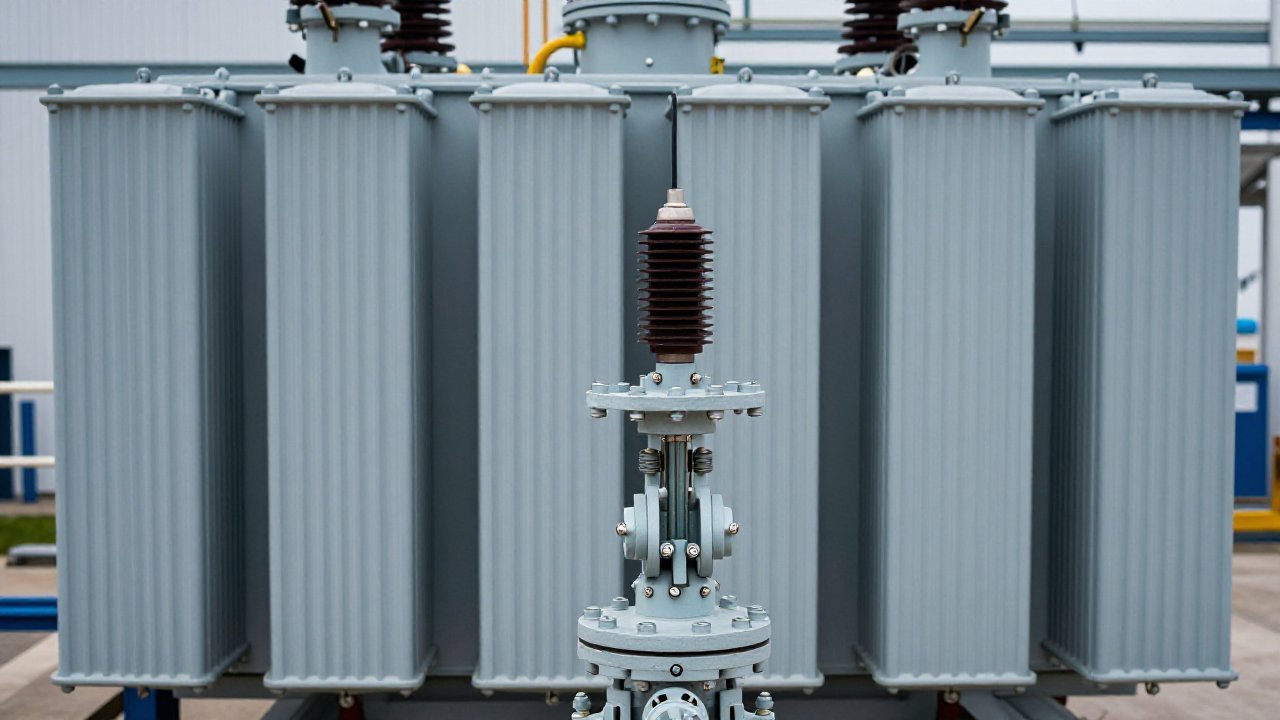
In August 2026 a monitoring supplier launched a substation condition platform that folds online dissolved gas analysis, acoustic fingerprinting and UHF partial discharge detection into one diagnostic workflow; published work that year added a microstrip UHF antenna evaluated inside transformer tanks. For anyone planning a UHF partial discharge sensor transformer retrofit, the deciding question is not antenna quality but whether the sensor can be got inside a tank already in service.
Why the oil valve is where UHF goes in
UHF sensing works in the 300–1500 MHz band: a discharge inside the tank radiates electromagnetic energy that the steel enclosure largely confines, so the antenna must sit inside or couple through an opening. On a transformer in service there are only a handful of openings — the oil valves, the drain valve, the manhole plates. The oil valve is the practical default: small, already flanged and sealed, and able to carry a purpose-made adapter on the oil side without disturbing anything else. That constraint shapes every UHF partial discharge sensor transformer specification.
An oil-valve sensor couples through the oil and connects to nothing in the main circuit: no galvanic path to the winding, no change to protection settings, no outage caused by the installation itself. Placement is the trade-off. The valve map is fixed, so one sensor may sit far from the discharge site, and attenuation across the tank makes that distance count. That is why UHF installations are usually specified with three or more sensors — better coverage, and the arrival-time differences that source localization depends on.
What a live installation actually requires
| Requirement | Why it matters |
|---|---|
| Sealed valve adapter and oil-tight feedthrough | The tank stays closed throughout; no oil is drained, lost or topped up afterwards |
| Closed oil circuit, zero oil consumption | No oil movement or air ingress that would perturb the unit’s own DGA readings |
| No galvanic connection to the main circuit | Work proceeds on an energized transformer without touching protection or metering |
| Written method statement and work permit | Live work on an energized unit is a controlled activity with a defined sequence |
| Sensor map recorded in the asset database | Port position is an input to localization; without it, timing data cannot be used |
| Bonding and floating-part check | A poorly bonded metallic part radiates its own PD-like signature and poisons the baseline |
Each item is a place where a low-cost bid quietly cuts scope, and the signal chain is where the difference shows up next.
From signal to diagnosis
A UHF channel on its own tells you that something is discharging, not what or where. In practice it is combined with HFCT clamps on the grounding and neutral paths, which catch pulse current and help rule out external interference, and optionally with acoustic sensing as a second view. The raw pulses are stored as phase-resolved plots — the subject of our PRPD and PRPS pattern analysis guide — and matched against known defect signatures, with trend treated as more important than any single reading.
The acquisition layer is where a specification earns its keep. Vendor data for an industrial-grade unit: UHF, RF, acoustic and HFCT inputs into one IED; 125 MS/s, 14-bit sampling with inter-channel skew under 100 ns; a sensitivity floor around 5 pC; 600 kV lightning impulse withstand; −30 to 60 °C; and IEC 61850 (DL/T 860) plus Modbus outputs so PD data lands beside dissolved gas data. Retrofit packages are commonly quoted in the low tens of thousands of US dollars, which makes sensor count, not the software licence, the main cost lever.
FAQ: Can UHF partial discharge monitoring be retrofitted without an outage?
For valve- and manhole-port designs, yes. The antenna couples internally through an existing opening, needs no galvanic connection to the main circuit, and the tank is never opened. A UHF partial discharge sensor transformer retrofit of this kind is the standard route for units that cannot come out of service; anything needing the tank opened, the oil drained or a bushing disturbed stays outage work. Confirm the method statement, the permit regime for energized work, and the pressure and oil-tightness qualification of the sensor and adapter.
FAQ: Which standards apply to UHF PD measurement?
IEC TS 62478:2016 covers non-conventional online PD measurement, with GB/T 42287 as its Chinese equivalent, and DL/T 1498.1 addresses online monitoring devices generally. T/CSEE 0421 deals specifically with UHF sensor installation through oil valves on 110 kV and above; IEC 60270 remains the conventional laboratory reference. One boundary matters: IEEE C57.127 covers acoustic emission and should never be cited for UHF. Monitoring products are designed in line with these documents — a claim of type testing should always be backed by the actual report.
Instrument the tank, then watch the trend
Designed on those principles, the TPD-400 online PD monitoring system accepts UHF, RF, acoustic and HFCT inputs into one industrial IED with 125 MS/s, 14-bit acquisition (vendor data), 2D and 3D phase-resolved plots and a pattern-recognition engine. It answers what is discharging and where; dissolved gas analysis answers how the fault is developing, and PAS DGA builds both halves — the DGA-900 nine-gas monitor, the dissolved hydrogen sensor range, and the dissolved hydrogen compliance baseline. The relationship between the disciplines is in our PD versus DGA comparison, with fleet rollout under power utilities.
Talk to us about specifying an oil-valve PD retrofit for your transformers.