
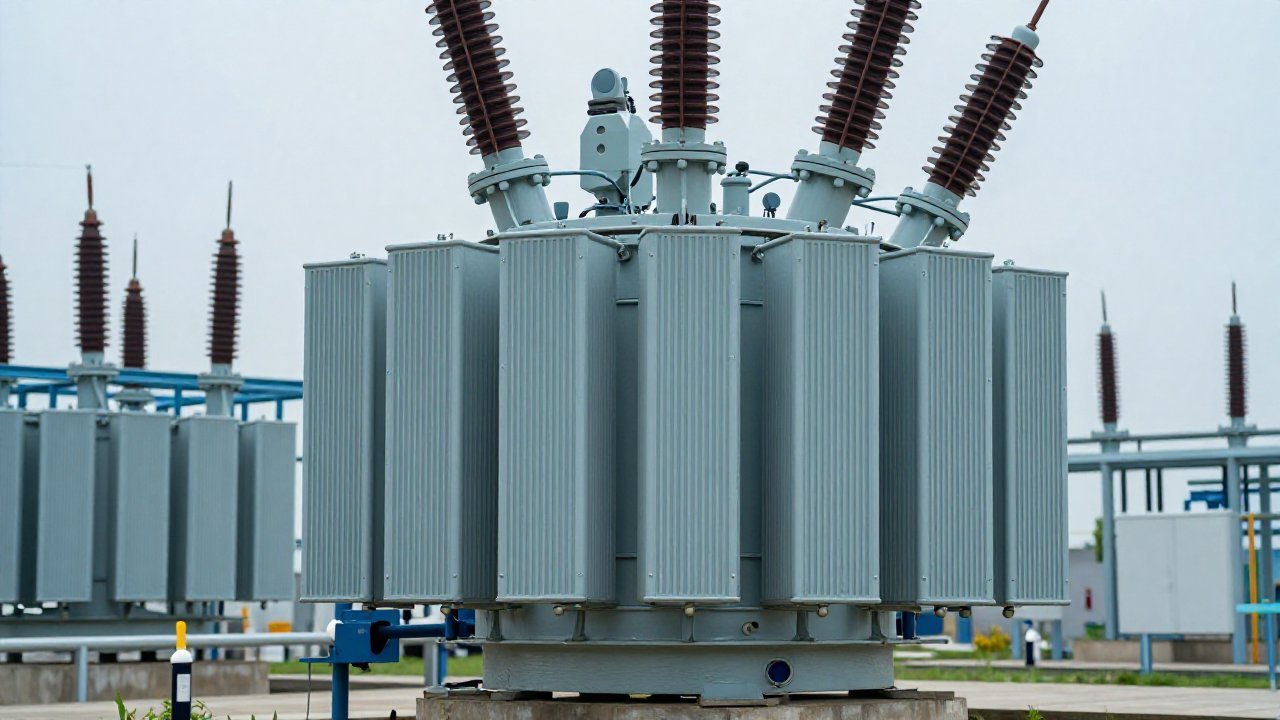
In September 2026 a Chinese monitoring vendor completed delivery of an integrated transformer condition platform for a thermal power plant in Guangdong, combining oil and gas sensing with partial discharge (PD) measurement. Ultrasonic sensors locate the discharge, ultra-high-frequency (UHF) sensors identify its type, and a fusion layer turns the two into a discharge map. A week earlier, a granted patent from China XD addressed how to draw a PD map for DC equipment, where the classic AC phase-resolved methods do not apply. Both point at the same craft: PRPD PRPS pattern analysis is what turns raw pulses into a diagnosis.
What PRPD and PRPS actually record
A PD pulse lasts nanoseconds to microseconds and carries an apparent charge measured in picocoulombs (pC). Because it repeats in step with the AC cycle, the useful way to store it is phase-resolved. PRPD — phase-resolved partial discharge — plots magnitude against phase angle accumulated over many cycles, so a defect produces a stable shape. PRPS — phase-resolved pulse sequence — keeps each pulse in sequence instead, preserving the timing between consecutive events. PRPD is the summary; PRPS still holds intermittent behaviour and the way a defect shifts under load or temperature.
Reading the pattern
Defects sit in different places on the phase axis and spread amplitude differently, which is what makes PRPD PRPS pattern analysis diagnostic rather than merely descriptive.
| Defect | Phase-resolved signature | What it suggests |
|---|---|---|
| Internal void discharge | Two clusters, roughly symmetric about the zero crossings, similar amplitude in both half-cycles | Gas-filled cavity in solid or paper insulation |
| Surface discharge | Asymmetric clusters concentrated near a specific phase band | Tracking along a contaminated or aged surface |
| Corona | Sharp, stable pulses at one phase extreme with low jitter | Often external — confirm the source is not the test arrangement |
| Floating potential | Highly irregular amplitudes at reproducible phase positions | Poorly bonded metallic part — check connections early |
| Oil-gap and tip discharge | Broad amplitude scatter across several phase bands | Sharp metal protrusions or oil gaps in the insulation structure |
These shapes let an engineer separate a harmless external corona from paper eroding inside the tank, and they are why automated classifiers exist — reading plots by eye across a fleet does not scale.
Why a pattern alone will not locate the source
PRPD PRPS pattern analysis tells you what is discharging, not where. Localization needs a second physical channel. With UHF, several sensors catch the same pulse at slightly different times, and the arrival-time differences are compared against a time-difference table or an electromagnetic simulation of the tank; a published study using this approach reported localization errors well under a metre, noting that the core and windings distort propagation. Acoustic sensing triangulates from ultrasonic travel times instead, though reflections complicate the geometry. The two are normally used together — the acoustic-electric fusion the Guangdong delivery put into service.
Real substations are electrically noisy, so the working sequence is capture, de-noise, separate, classify. Adaptive thresholding strips environmental interference, and separation methods such as 3PARD split superimposed sources, since a transformer can host more than one discharge site at once. Classification then matches the cleaned pattern against known signatures, from feature-plus-SVM pipelines to convolutional and LSTM networks. No responsible vendor should promise a guaranteed identification rate; the value is a ranked, trendable diagnosis.
FAQ: Can PRPD analysis be used on DC equipment?
Not directly. Phase-resolved analysis depends on a repeating AC cycle to supply the phase reference, and DC equipment has no such cycle — the gap the September 2026 China XD patent addresses. For HVDC projects, ask how a vendor establishes phase reference, not just whether the system supports UHF.
FAQ: What should I specify in an online PD monitoring system?
- Sensor inputs: UHF at oil-valve or manhole ports, plus HFCT on grounding and neutral paths; acoustic or RF as options.
- Acquisition: synchronized multichannel sampling in the 100 MS/s class at 12–14 bit, with inter-channel skew in the tens of nanoseconds.
- Analysis: 2D and 3D PRPD/PRPS plots, source separation, pattern recognition with trend-first alarm logic.
- Sensitivity: a usable floor in the single-digit pC range, with a stable baseline so trends stay meaningful.
- Integration: IEC 61850 (DL/T 860) and Modbus outputs so PD data sits beside dissolved gas and load data.
The framework for online, non-conventional PD measurement is IEC TS 62478 and its Chinese equivalent GB/T 42287, with DL/T 1498.1 covering online monitoring devices; laboratory work follows IEC 60270. IEEE C57.127 applies to acoustic methods only. Any type-test claim should be backed by an actual report.
Instrument both sides of insulation health
Designed on those principles, the TPD-400 online PD monitoring system takes UHF, RF, acoustic and HFCT inputs into one industrial IED with synchronized 125 MS/s, 14-bit acquisition (vendor data), 2D/3D phase-resolved plots and a pattern-recognition engine. PD answers what is discharging and where; dissolved gas analysis answers how the fault is developing. PAS DGA builds both halves — the DGA-900 nine-gas monitor, the dissolved hydrogen sensor range, and the dissolved hydrogen compliance baseline. The relationship between the two is set out in our PD versus DGA comparison.
Talk to us about specifying online partial discharge monitoring for your transformers.