
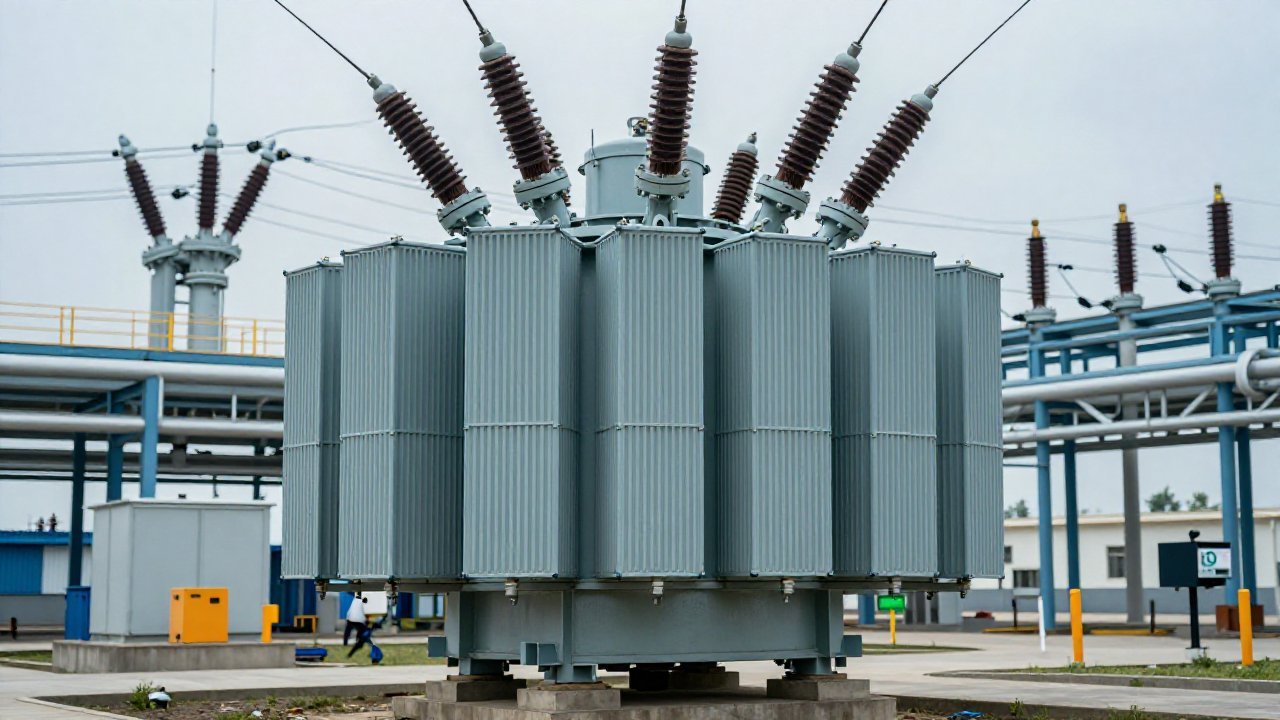
Acetylene (C2H2) is the least forgiving gas in a transformer’s dissolved-gas profile. It forms at the energy of arcing, sparking discharges and very hot spots, and once it appears in a high-voltage asset the real question is not whether the asset is healthy — it is how fast the condition is growing. Periodic laboratory oil sampling answers that question on a timescale of months. Continuous online DGA acetylene early detection answers it in hours or days. The three anonymized field records below come from PAS DGA laser-photoacoustic installations on AC transmission networks. Every one of them began with acetylene well below a classic alarm level — between 0.15 and 0.8 µL/L — and every one was acted on before it became a failure.
Why acetylene is the early-warning gas that matters
Acetylene is the characteristic gas of high-energy faults: partial discharge in oil, sparking, and arcing that can carbonize paper and pit conductors in a short time. Because it is so specific, even a trace reading changes how an operator reads every other gas. The difficulty is that trace values sit close to the detection floor of conventional methods, and a slow rise can be invisible between two lab samples taken months apart.
A laser-photoacoustic online monitor changes that picture. With an acetylene detection limit of 0.05 µL/L (product specification of the PAS DGA DGA-900 platform) and essentially no cross-interference from other gases, it puts a trustworthy C2H2 number on the desk every measurement cycle — not every quarter.
Three AC-substation records at a glance
| Record | Asset | First C2H2 signal | Online vs offline | Outcome |
|---|---|---|---|---|
| 1 | 1000 kV UHV shunt reactor (spare unit) | ≈0.15–0.17 µL/L by lab shortly after commissioning | Online on two phases matched the lab reading | Slow rise tracked for months; defective spare replaced; monitors still running 2+ years |
| 2 | 500 kV main transformer | Trace C2H2 while loaded | Online confirmed it; gas persisted after load transfer at no-load | Slow rise, then a plateau; unit kept under long-term monitoring |
| 3 | 500 kV transformer | 0.2 µL/L online (Aug), lab 0.18 µL/L | Δ ≈0.02 µL/L | Rose to ≈0.8 µL/L; phase replaced in October; hazard removed |
Case 1 — A 1000 kV reactor spare that was never healthy
A 1000 kV UHV shunt reactor was damaged after a lightning strike on the line, and the operator replaced it with a spare unit. Shortly after the spare was commissioned, routine laboratory chromatography showed trace acetylene at roughly 0.15–0.17 µL/L — present, but far below any alarm threshold. Because the level was so low, the operator wanted a second, continuous opinion before deciding whether the spare was sound.
Two laser-photoacoustic online DGA monitors were redeployed onto two phases of the reactor. They detected the trace acetylene immediately, and their readings sat very close to the laboratory figures — a direct field confirmation that the online numbers could be trusted at the 0.1 µL/L scale. Over the following months the acetylene crept upward, and the monitors tracked the rise curve day by day. The spare reactor was eventually confirmed defective and replaced. The two monitors continued to run normally for more than two years afterwards.
Case 2 — A 500 kV transformer that kept producing gas at no-load
A 500 kV main transformer began generating acetylene while in service. The operator first did the obvious check: transferred the load and ran the unit at no-load to see whether the gas was load-driven. The acetylene persisted. That single observation — gas at no-load — pointed to an internal, electrically active source rather than an overload condition, and it turned a routine data point into a maintenance decision.
A laser-photoacoustic monitor was redeployed from another site where it was still being installed, and connected to the transformer. It immediately confirmed the trace acetylene and, more importantly, showed that the gas was rising slowly rather than stabilizing. The slow rise continued to a plateau and then held stable, so the unit could be kept in service under continuous watch. That monitor has remained on the transformer since, providing the long-term trend that periodic sampling could not.
Case 3 — 0.2 µL/L today, transformer changed 60 days later
In August 2024, a fleet of nine online DGA monitors was commissioned at a 500 kV substation serving a coastal metropolitan grid. One of them caught the first appearance of acetylene on its transformer at 0.2 µL/L. Laboratory verification returned 0.18 µL/L — an agreement of roughly 0.02 µL/L between online and offline methods at a level most operators would consider noise.
The monitor kept tracking. Over the following weeks the acetylene rose steadily to about 0.8 µL/L, converting a “trace” into a clear trend. That trend was the basis for an early defect finding, and the substation operator completed replacement of the affected phase in October, removing the hazard on a planned schedule rather than after a failure.
What the three records share
- Online confirmed the lab at trace level. In Case 1 and Case 3 the online reading matched the laboratory within about 0.02–0.05 µL/L — the accuracy that lets an operator trust a continuous channel for decisions.
- The time-axis is the value. The lab said “traces”; the online monitor said “rising since installation.” A rate can only be seen with a continuous record.
- Trace acetylene was treated as actionable. None of these cases waited for a conventional alarm. The earliest credible signal was the action trigger.
- Long-term stability matters. Monitors in these records ran for years, because an early-warning channel that drifts or fails is worse than none.
Q: What acetylene level is “dangerous”? A: Guides such as IEEE C57.104 and IEC 60599 assign condition levels rather than a single danger line, and the condition escalates with a sustained increase. The practical lesson of these records is that the trend — not the absolute number — is what should drive the next action.
Q: Does online DGA replace laboratory oil sampling? A: No — the two are complementary. In every case above the laboratory was the confirming authority, while the online monitor supplied continuity between samples and caught the moment of change.
Put this early-warning capability on your fleet
The DGA-900 laser-photoacoustic online monitor is the product platform behind these records — full fault-gas coverage, an acetylene detection limit of 0.05 µL/L, and no carrier gas or consumables. If trace acetylene on a reactor or transformer would change how you plan maintenance, that is the place to start. For the broader picture, see our real-world DGA fault detection cases, the UHV transformer monitoring guide, or the technology behind laser photoacoustic spectroscopy. For a single-asset walkthrough of the same acetylene pattern, the 220 kV transformer acetylene escalation case follows one unit from a zero baseline to 2.99 µL/L in eleven hours. Contact PAS DGA to discuss the early-warning case for your fleet.