
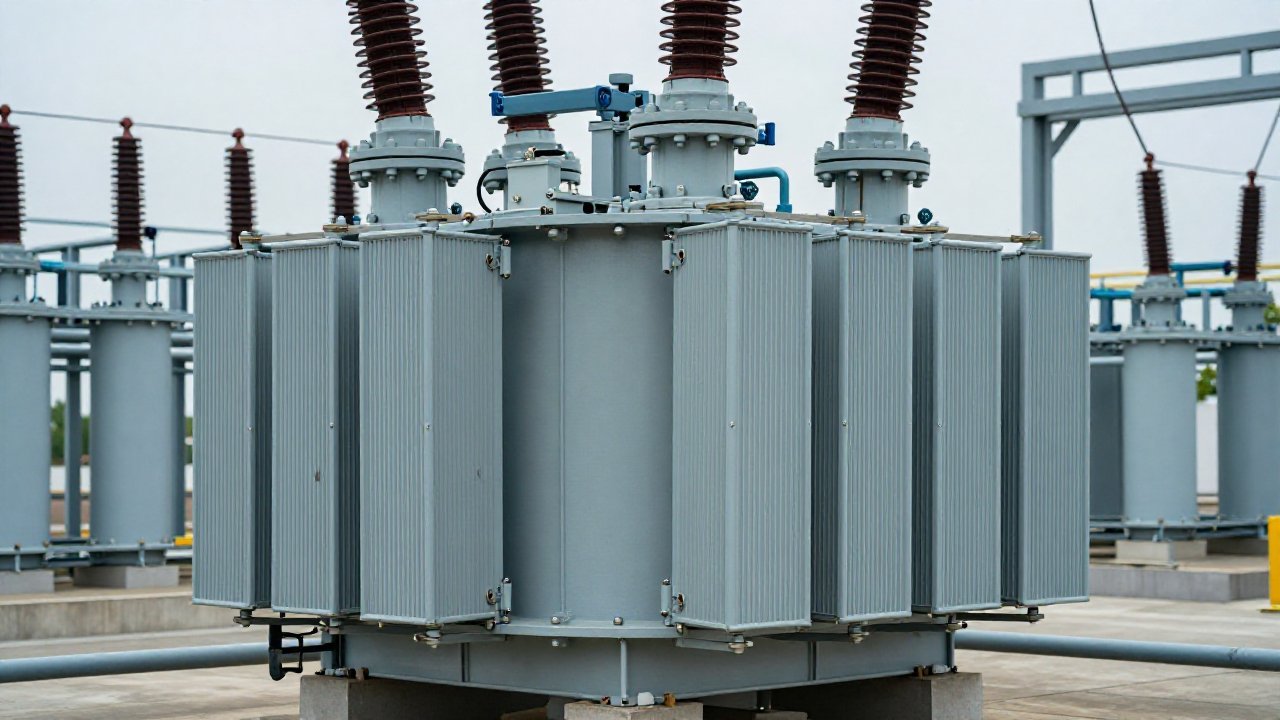
At the CIGRE Paris Session 2026, Chubu Electric Power Grid and AICHI Electric presented an IoT-based transformer monitoring device that fits onto existing units without a planned outage. Its dissolved gas analysis (DGA) channel starts with hydrogen concentration monitoring — the first gas most developing faults release. For engineers asking how does dissolved hydrogen monitoring work, the short answer is a gas-permeable membrane, a palladium sensing layer, and alarm logic that watches both level and speed of change.
Hydrogen: the gas that gets there first
Transformer oil and paper insulation break down under heat and electrical stress into a family of gases. Hydrogen appears in nearly every scenario — from about 150 °C up through the arcing range above 800 °C, and from partial discharge too. That broad footprint makes it the cheapest early-warning channel to install across many units.
Standards back this up. IEEE C57.104-2019 keeps hydrogen below 100 ppm in Condition 1; by Condition 4 the unit is on daily or continuous monitoring. Since 1 July 2026, China’s NDRC Order No. 41 treats 450 µL/L of dissolved hydrogen as an enforceable hazard threshold on UHV converter transformers. With market reports putting roughly 70% of US transformers past 25 years of service, a hydrogen channel is often the first practical step.
From oil to signal: membrane and sensing layer
A monitor must put oil in contact with a sensing surface, so most online hydrogen monitors mount on the transformer’s oil valve: oil flows past a gas-permeable membrane — typically PTFE or a thin AF2400-type layer — and hydrogen partitions into the gas phase until it reaches equilibrium. This closed oil circuit consumes no oil and disturbs nothing, which is why the retrofit can be done on an energized transformer without taking it out of service.
The sensing step is the core of how does dissolved hydrogen monitoring work. Palladium absorbs hydrogen selectively, forming palladium hydride and changing a measurable property. Designs differ mainly in which property they read:
| Transducer family | Sensing element | Signal | Published detection limit |
|---|---|---|---|
| Resistive | Palladium thin film or nanowire array | Resistance rises with absorbed H₂ | ~2–3 ppm |
| Electrochemical | Pd–Ni nanoalloy with solid ionogel electrolyte | Oxidation current proportional to H₂ | sub-ppm |
| Optical fiber | Palladium-coated fiber Bragg grating | Wavelength shift from film strain | ~15 ppm |
Limits above are published research figures; commercial products state their own vendor data. The practical requirement is the same everywhere: resolve hydrogen below 100 ppm and hold calibration over a year or more. A 2026 study in the Chemical Engineering Journal showed why materials matter — a mechanism-guided Pd0.8Ni0.2 nanoalloy probe with an ionogel electrolyte kept a stable electrochemical reading in viscous oil, addressing the drift of wet-electrolyte designs.
From ppm to an alarm
The monitor reports dissolved hydrogen in ppm, but a number alone is not enough. Practical alarm logic uses two dimensions: the absolute level — how far the reading sits from the IEEE C57.104 Condition boundaries — and the rate of rise, where a slow climb over months differs from a doubling in a week. Response time matters here, and T63 — the time to reach 63% of the final reading — depends on membrane permeation, cell volume and oil flow; our guide to T63 response time covers the trade-offs.
Once hydrogen is trending, the reading feeds interpretation: key-gas logic, gas ratios and the Duval triangle when a multi-gas sample is available. Hydrogen gives the fleet-wide tripwire; interpretation turns it into a fault type.
A hydrogen channel is a screening tool, not a diagnosis. It will flag a developing problem far earlier than a routine oil sample, but it will not say whether the cause is overheating, partial discharge or arcing. That is why the standard pattern is hydrogen across the fleet, then a multi-gas confirm where risk is highest — our hydrogen-only versus multi-gas comparison sets out the logic, and the nine-gas DGA-900 covers the full picture when a transformer justifies it.
How does dissolved hydrogen monitoring work without opening the transformer?
The sensor connects to the existing oil valve; a gas-permeable membrane separates the oil from the sensing element. Hydrogen crosses into equilibrium with the gas phase, so the measurement happens in a sealed, closed oil circuit while the transformer stays energized.
How fast does a dissolved hydrogen sensor respond?
Fast enough for early warning — typical online hydrogen monitors reach their reading within minutes, measured as T63. Exact speed depends on membrane area, cell volume and oil flow, and matters for rate-of-rise alarms: a rapidly developing fault must be caught before the next sample.
Can a hydrogen monitor identify which fault is developing?
No. Hydrogen says a fault is forming, not which one. Identifying the fault type needs a broader gas picture — gas ratios, Duval triangle or a multi-gas analyzer. Screening with hydrogen and confirming with multi-gas is the pattern utilities are converging on.
If you want hydrogen monitoring on a transformer class or fleet, our engineers can map the sensor to your valve configuration. Contact us to discuss your dissolved hydrogen monitoring program.