
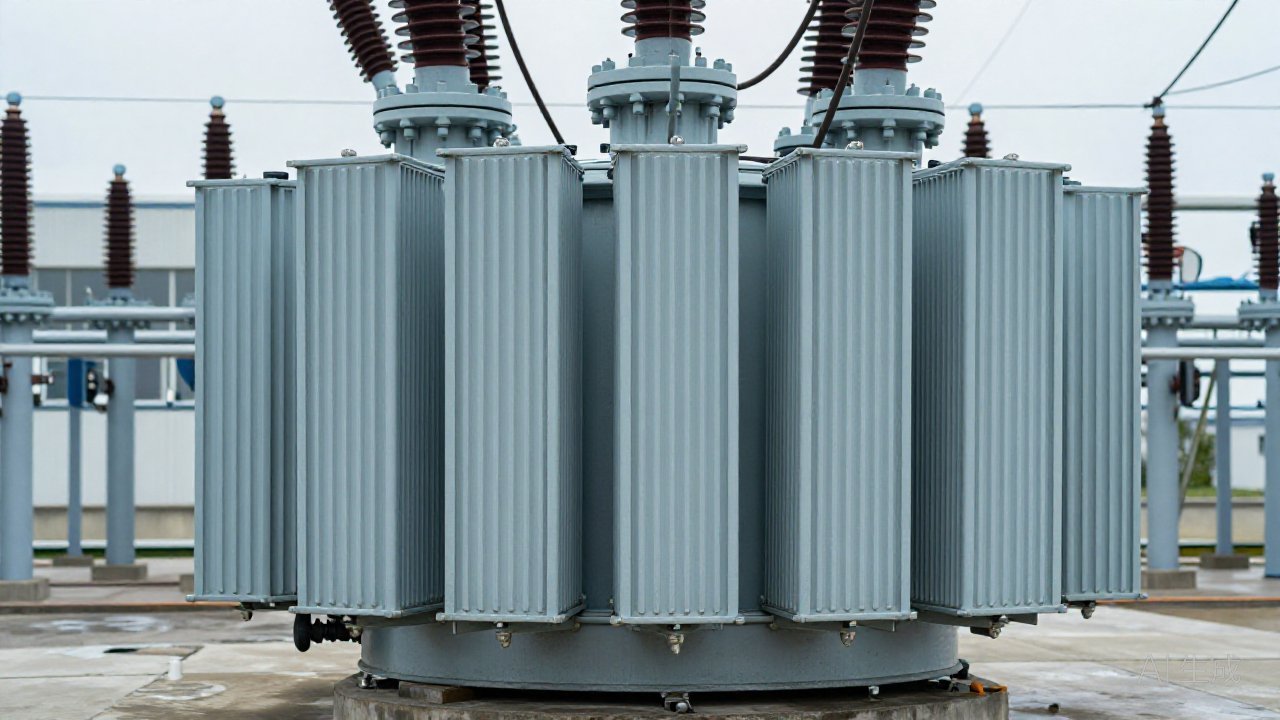
On 15 October 2026 an industry analysis cited by Modern Power Systems put average European and US transformer fleet ages at 35–40 years against a 25–30-year design life, with lead times of two to three years for large units and prices nearly doubling since 2020. T&D World made the load-side argument two days earlier: data-centre demand does not pause for a replacement schedule. When a new transformer cannot be bought in time, the fleet has to be watched rather than renewed, and retrofit partial discharge monitoring becomes a scheduling decision rather than a procurement one.
Why retrofit instead of replace
Partial discharge is an electrical symptom that appears before the chemistry records it. A defect in insulation releases pulses in nanoseconds and microseconds; the gases that DGA measures accumulate over hours and days. That is the argument for adding a PD channel to an ageing unit: it buys time on the asset you already have.
Retrofit also fits the constraint that governs most sites: the transformer cannot be taken out of service. Oil-valve couplers and clamp-on sensors install on an energised tank, so the practical question is which mounting point is worth using.
Ranking the fleet on four factors
A retrofit partial discharge monitoring programme that instruments everything at once is a budget request, not a plan. A ranked shortlist is easier to fund and easier to defend after the first alarm.
| Factor | What to read | Why it moves a unit up |
|---|---|---|
| Design and age | Bushing type, tap-changer design, pre-1990 insulation practice | Known weak points that degrade silently |
| Duty | Loading profile, harmonic content, cyclic data-centre load | Higher field stress and more thermal cycling |
| Chemistry history | DGA trend, previous gassing, moisture excursions | A unit already talking is the cheapest to instrument |
| Consequence | Single-transformer sites, repair lead time, load at risk | Failure cost dominates the business case |
The chemistry column links the two disciplines. A transformer whose gas trend has started to climb is a better candidate than one with the same age and no history, because the monitoring has something to correlate against. Where the budget covers only the electrical side, pairing the PD channel with a multi-gas DGA monitor closes the loop, and the division of labour between the two is set out in PD versus DGA monitoring.
The sensor has to match the mounting point you actually have
Four sensing routes are common, and each fails differently. UHF couplers work in the 300–1500 MHz band (vendor data) and are usually fitted into an oil valve or inspection port, inside the tank, where the wall does not attenuate the signal; energised fitting practice on 110 kV and above is covered in oil valve UHF sensor retrofit. High-frequency current transformers clamp around a grounding or neutral connection and see the pulse current that leaves the tank, which makes them easy to install but blind to a discharge with no path through that conductor.
Acoustic sensors (80–200 kHz) mount outside the tank wall and need no outage, at the cost of attenuation through oil and steel; IEEE Std C57.127 addresses acoustic measurement only, and cannot be cited for UHF or HFCT methods. RF antennas hear a wide band, and therefore everything else in the yard too.
Bushings deserve their own line. End-screen or tap-point monitoring reaches a failure mode a tank-mounted sensor may never see, so bushing partial discharge monitoring is usually budgeted separately.
The first thirty days decide whether the retrofit was worth it
A newly installed channel produces a number immediately and a baseline only after it has seen normal operation. Alarming on the first reading earns a reputation for false alarms. Record a baseline over several weeks, verify that the channel still responds by injecting a known pulse at the coupler, and only then set the threshold as a deviation from that baseline.
A factory-fitted system is specified at design stage; a retrofit makes the same choices with what the tank offers (see permanent PD monitoring system specification). The ranges in online PD monitoring cost are market reports, not quotations.
A four-input unit such as the TPD-400 is built for this situation, with UHF, HFCT, acoustic and RF channels sharing a time base (vendor data) so one event can be confirmed on more than one path. The unit is designed in line with IEC TS 62478 / GB/T 42287 for non-conventional measurement, with IEC 61850 (DL/T 860) and DL/T 1498.1 for the station interface; that describes a method, not a certificate.
Which transformers should be instrumented first in an ageing fleet?
The ones that combine a known design weakness, high consequence of failure and an active DGA record. Age alone ranks a fleet poorly; consequence and chemistry rank it well.
Can a PD sensor be installed without taking the transformer out of service?
Oil-valve UHF couplers and clamp-on HFCTs are normally fitted with the unit energised, which is why they dominate retrofit projects. Acoustic sensors on the tank wall are also external. Any work on the tank itself still follows the utility’s own safety procedure.
Programmes usually start where most load is at risk; the utility-side view in power utilities applications reads more like an outage plan than an instrument catalogue. To rank a fleet for retrofit partial discharge monitoring, or to scope a pilot on two or three units, send the asset list through the contact form with TPD-400 preselected.