
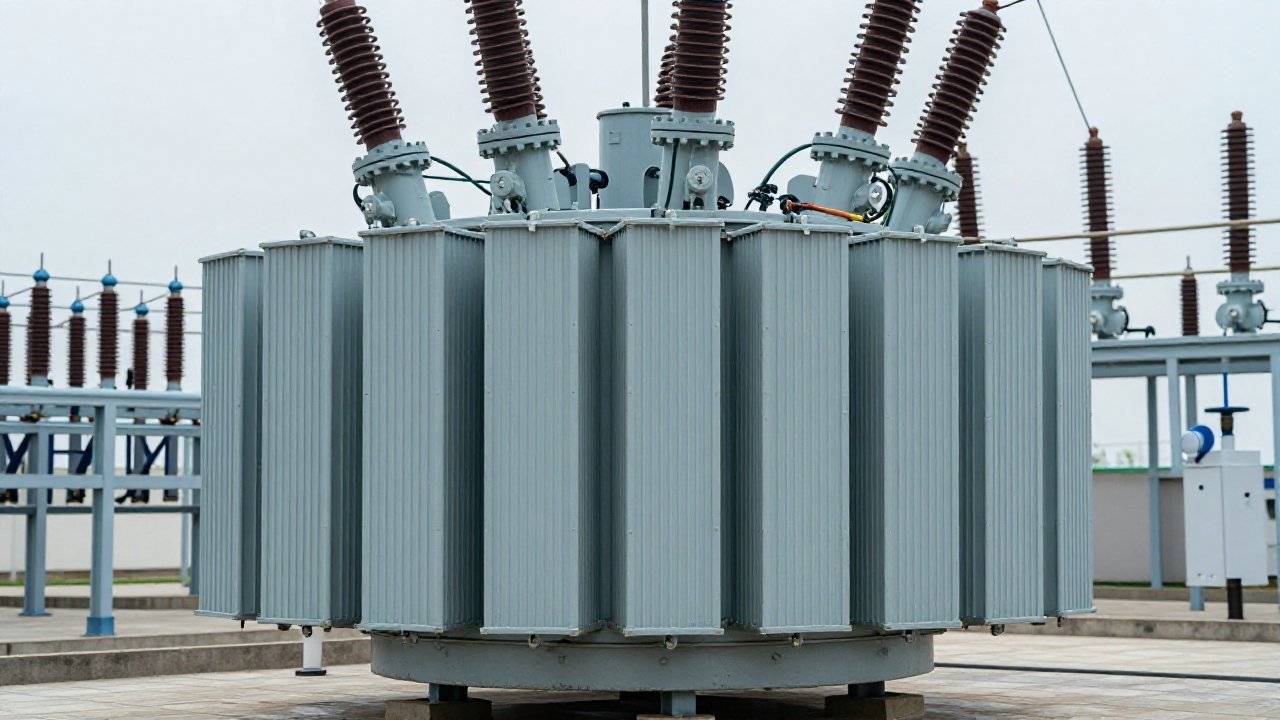
On 24 June 2026, Airports Company South Africa issued Request for Information 74393 for a permanent on-line partial discharge monitoring system on the 11 kV network at O.R. Tambo International Airport: at least 24 sensors across cables, switchgear, transformers and busbars, integrated into SCADA. Scope that broad rarely attracts clustered bids, and the reason is most of what partial discharge monitoring cost actually is.
The cost that never reaches the quotation
A vendor quotation lists hardware and labour. The project’s largest line is usually the time the transformer spends de-energised, and it appears on nobody’s invoice. A UHF coupler at an oil valve goes onto a unit that stays in service. A sensor that must sit inside the tank, or an HFCT opened around a cable core, wants the transformer out, in a window operations may have promised elsewhere.
Two buyers of “one transformer’s worth” of PD monitoring can therefore get quotes a factor of three apart and both be reasonable. One is buying a live retrofit; the other is buying an outage and a deferred maintenance slot, and pricing only the box.
What drives partial discharge monitoring cost
Six elements move the number.
| Cost element | Drives it up | Drives it down | Ask the vendor |
|---|---|---|---|
| Sensing channels | More locations; a wider mix of methods | Two or three likely source locations | Channels, types, cost per extra channel? |
| Installation method | Sensors needing internal access or an outage | A coupler at an existing oil valve, unit in service | Which channels need the unit de-energised? |
| Monitoring IED | Channel count; acquisition spec | One unit shared across several bays | Channel capacity, and expansion module cost? |
| Cabling and cabinet | Long runs, tray work, a harsh location | Mounting the unit near the sensors | Cable type and length assumed, and who supplies it? |
| Integration | SCADA point mapping, fibre, cybersecurity review | Reusing the existing substation LAN | Is integration engineering included, and who maps points? |
| Software and analysis | Per-sensor licensing, vendor analysis service, renewal | Exporting into a platform you already run | Licensed per sensor or per system, and year-two cost? |
Market reports put the PD monitoring systems market at roughly USD 0.5 to 0.9 billion, the wider transformer monitoring market at about USD 3.1 billion in 2026 rising to about USD 5.0 billion by 2031 at roughly 10 % CAGR, and a single-unit retrofit package at USD 20,000 to 60,000 (market reports). Planning bands, not quotations.
How do you normalise two quotes?
- Same channel count and mix. Six UHF channels and six mixed UHF/HFCT/acoustic channels are different products.
- Same sensing coverage. A UHF-only scope and one that also watches acoustic emission and cable grounds answer different questions.
- Same installation scope. Fix who supplies cable, who terminates and commissions, and whether the outage is inside the price.
- Same warranty, itemised. Sensors, unit and software separately, with spares and response time named.
- Then compare headline numbers. A cheaper quote is frequently a narrower one.
Total cost over life, not purchase price
Recurring items are where two similar first invoices diverge. Ask for the software licence basis and renewal price, whether analysis is included or sold as a service, and the cost and lead time of a spare sensor. Online PD measurement has no consumable gas or column, which removes one recurring line but not licensing, spares or support.
FAQ: reading a partial discharge monitoring cost quotation
Do I have to take an outage to install online PD monitoring?
Not always, and the answer decides the budget. A coupler at an oil valve goes onto an energised unit; sensors needing tank entry cannot. Ask which channels are which before signing.
Why can two quotes for the same substation differ threefold?
Usually channel count and installation scope, not the sensor brand. One quote assumes you handle cabling, integration and switching; the other is turnkey. Normalise the scope and the gap narrows.
What recurring costs should I expect after year one?
Software licensing or support, spare sensors, any analysis service, and integration work at the next network upgrade. Ask for a five-year number.
Sources
- Airports Company South Africa, Request for Information 74393, for supply, installation and commissioning of an on-line partial discharge monitoring system for 11 kV electrical equipment, published 24 June 2026 via eTenders.gov.za.
- IEC TS 62478:2016 (non-conventional, on-line PD measurement; GB/T 42287); IEC 60270; DL/T 1498.1; IEC 61850 (DL/T 860); IEEE C57.127 (acoustic emission only).
- Market bands are ranges from published market-research reports (market reports), planning inputs only. TPD-400 figures: vendor data.
Buying the monitoring, not just the box
The TPD-400 is designed in line with IEC TS 62478:2016 and GB/T 42287 for non-conventional on-line PD measurement, reporting over IEC 61850 (DL/T 860) under DL/T 1498.1. It takes UHF (300 to 1500 MHz at an oil valve or manhole), HFCT (0.3 to 30 MHz), acoustic emission (80 to 200 kHz) and RF inputs into one IED: 125 MS/s, 14-bit, channel synchronisation better than 100 ns, minimum measurable apparent charge around 5 pC, local cabinet at -30 to 60 °C (vendor data). UHF time-of-flight aids source location, not guaranteed. Pair it with a DGA-900 nine-gas analyser — see PD versus DGA and utility-wide deployment. Channel count and installation scope set the price, so PAS DGA quotes each project individually.