
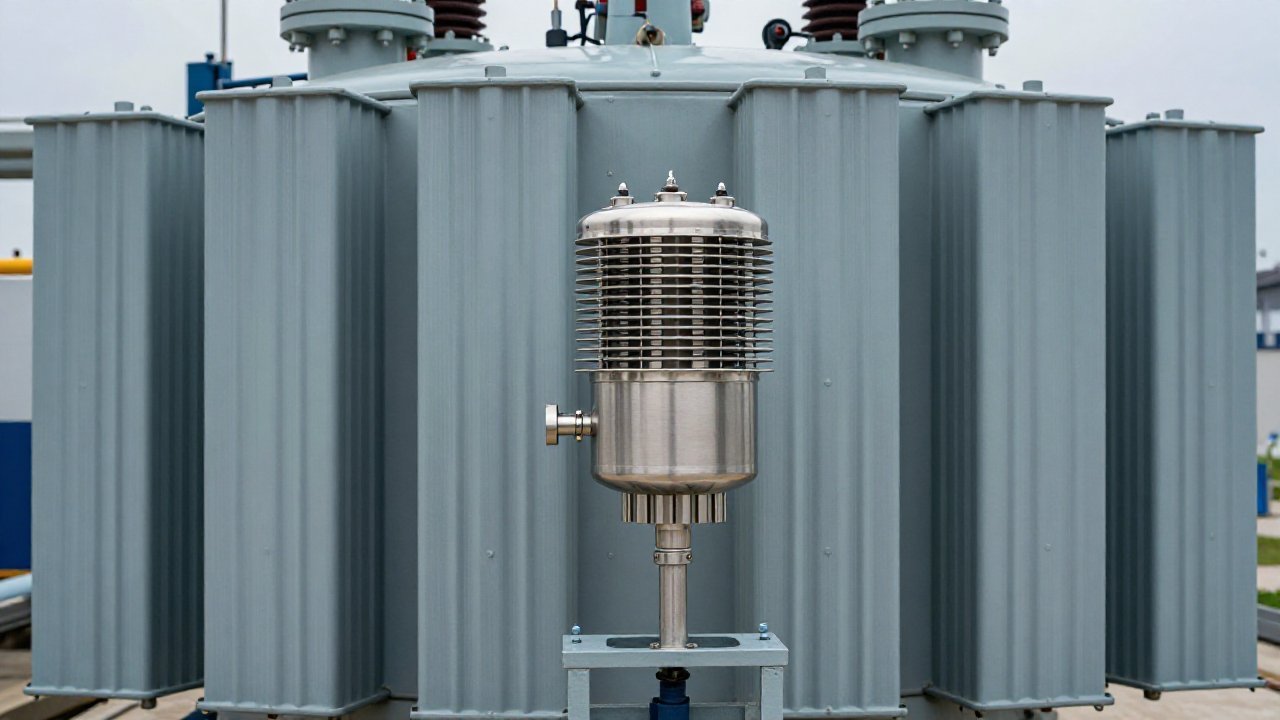
A DGA sensor specification begins as a datasheet and judged in transformer oil, and most specification mistakes are made in the gap between them. Two sensors can print the same range and detection limit yet behave differently in service, because the deciding figures often sit in footnotes — or are missing. This is a short checklist of the numbers worth verifying before a sensor enters a tender file.
Why a datasheet is not a specification
Dissolved gas analysis (DGA) measures gases that have already partitioned out of the oil, so every figure carries a hidden second half: the medium it was measured in. A detection limit quoted on dry standard gas and one quoted on transformer oil are not the same number, and the gap can be an order of magnitude. Accuracy follows the same logic. IEC 60567:2023 sets a ±15% acceptance target for gas-in-oil results, but that target comes from round-robin tests that include oil–gas separation and exclude sampling, and it applies to laboratories and online monitors alike. It is not the accuracy of any detector.
The oil-to-gas stage, not the sensing element, sets the ceiling on what a monitor can resolve. Published error budgets put the detector at roughly 1–3%, extraction and degassing at 12–28%, and field sampling at 10–50% (Bräsel & Sasum, ew 2012, 111(14):50–55; CIGRE TB 783). A datasheet that describes only the detector describes the smallest term in the sum.
Detection limit and response time
Acetylene (C2H2) forces the question, because it points to a discharge fault and rises fast. Vendor-published detection limits for online monitors span two orders of magnitude: Qualitrol Serveron TM8 at 1 ppm, Vaisala OPT100 at ±0.5 ppm, Camlin TOTUS G9 at 0.1 ppm, and commercial L-PAS at ≤0.1 ppm, with one reference platform quoted at 0.05 ppm (all vendor data). The useful question is not which number is smallest, but whether the limit was measured in oil at operating temperature and reproduced on gas-in-oil standards.
Response time mixes two clocks that are not interchangeable. The T63 step response time describes how long the sensor takes to reach 63% of a step change once gas reaches the membrane; the measurement cycle describes how often it reports. A monitor can publish a fast cycle and a slow T63. For a discharge fault, where acetylene can double within hours, the T63 matters more, and it is set by membrane permeation, cell volume and flow — physical terms, not firmware.
Cross-sensitivity and the accuracy chain
Hydrogen and carbon monoxide frequently rise together in an ageing transformer, and a probe that responds to both without saying so reports a hydrogen trend that is partly a carbon-monoxide trend. A meaningful cross-sensitivity figure is a pair — the interfering gas concentration and the resulting deviation — not a bare percentage. A few µL/L of deviation under a high carbon-monoxide background is more useful than a claim of “no cross-response to other combustible gases”, a distinction unpacked in our guide to cross-sensitivity and selectivity.
Calibration is where a specification becomes a defensible number. The chain runs from certified gas-in-oil standards through extraction to the reported reading; leave any link unspecified and the end accuracy is unknown. The measurement principle itself is an architecture choice rather than a quality ranking, as set out in our 2026 technology comparison.
The DGA sensor specification checklist
| Figure | What the datasheet tends to say | What to verify |
|---|---|---|
| Detection limit (C2H2) | A single ppm value | Measured in oil or on dry gas; reproduced on gas-in-oil standards |
| Gas coverage | A count of gases | Which are measured directly, which by auxiliary channels (H2, O2, N2) |
| Response time | One time figure | T63 at operating oil temperature, distinct from the measurement cycle |
| Cross-sensitivity | “No cross-response” | Interfering gas, its background concentration, the resulting deviation |
| Accuracy | “±X%” | Basis of the figure; the ±15% target is not the detector’s accuracy |
| Environment | IP rating, temperature range | Calibration interval and the traceable standard behind it |
What detection limit should a DGA sensor quote for acetylene?
It should quote the limit it can hold in oil, not the best figure its detector reaches on a clean gas cell. Compare quoted limits only when the medium and method match.
Is ±15% the accuracy of a dissolved-gas sensor?
No. It is the IEC 60567:2023 acceptance target for gas-in-oil results, covering extraction and analysis but not sampling, and it defines the tolerance of a result rather than the precision of a device.
Specifying a DGA sensor with confidence
PAS DGA builds the sensor range used across the DGA-200, DGA-300 and DGA-500 hydrogen monitors, with the DGM-900 adding seven gases and moisture for fleets standardising on one platform. Each datasheet lists these figures with their measurement basis, and the photoacoustic principle behind the multi-gas instruments is documented separately. Drafting a DGA sensor specification? Send it through the contact page and we will return it marked up.
Sources: IEC 60567:2023; IEC 60599:2022; IEEE C57.104-2019; CIGRE TB 783 (error budget); Bräsel & Sasum, ew 2012, 111(14):50–55; vendor-published detection limits for Camlin TOTUS G9, Vaisala OPT100 and Qualitrol Serveron TM8 (vendor data).