
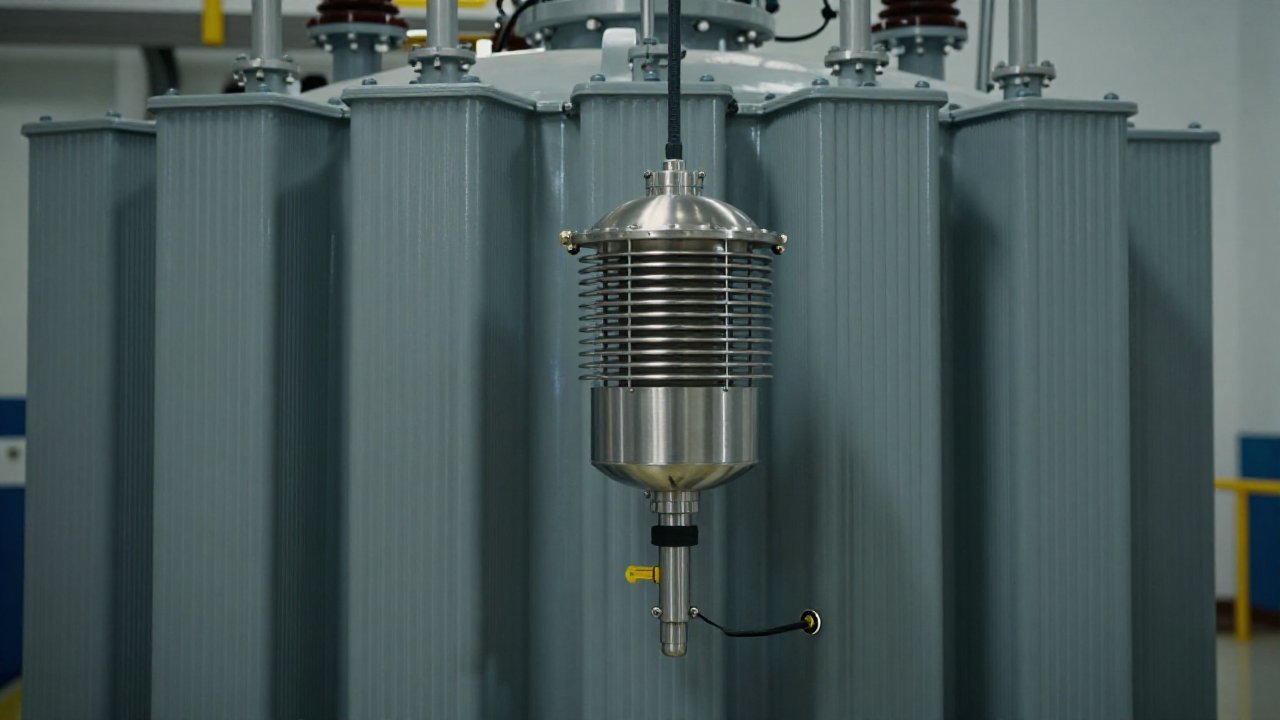
A paper added to IEEE Xplore on 18 September 2026 reported 90.9% accuracy and 90.2% macro F1 on a seven-class transformer fault benchmark built from dissolved gas analysis. A classifier is only as good as the numbers it is handed, and those numbers come out of a dga sensor sitting in transformer oil.
Open three supplier datasheets for a dga sensor and you meet three words used for the same idea: cross-sensitivity, selectivity and specificity. They do not mean the same thing. One is a measurement, one is a ratio, and one is a claim — and only the first two can be checked.
Three Words the Datasheets Use Loosely
| Term | What it actually is | What a defensible datasheet shows |
|---|---|---|
| Cross-sensitivity | A number: how far the hydrogen reading moves when a named interferent is present | Interferent, its background concentration, the resulting deviation |
| Selectivity | A ratio: response to hydrogen divided by response to the strongest interferent | Which gas was the strongest interferent, and the measured ratio |
| Specificity | A claim: the sensor responds only to hydrogen | Usually nothing — no interferent list, no concentration, no figure |
Specificity is the weakest of the three: as normally written it cannot be tested, and says nothing about which gases were tried, at what concentration, or at what temperature. Cross-sensitivity, quoted with its background, is the only one a third party can reproduce.
What a Cross-Sensitivity Figure Should Carry
A deviation stated alone — “less than 1%” — is not usable, because cross-sensitivity is a function of concentration, not a constant. Four details turn a claim into data:
- The interferent list. Which gases were introduced, and which left out.
- The background concentration. A deviation measured against 100 µL/L says little about behaviour at 2,000 µL/L.
- The oil temperature. Response is temperature-dependent, and loaded oil is not at room temperature.
- The concentration range. A figure quoted at the top of the range does not describe the bottom, where early faults appear.
A 2026 review in ACS Materials Letters reached a blunt conclusion on semiconductor gas-sensing materials for dissolved gas analysis: despite progress on sensitivity and response speed, long-term stability and cross-sensitivity remain unresolved in transformer oil. Every specificity claim is therefore provisional until someone publishes the test conditions.
Where Hydrogen and Carbon Monoxide Rise Together
Hydrogen is rarely alone. Carbon monoxide forms alongside it when cellulose insulation overheats, and incipient faults often produce both. A sensor that absorbs carbon monoxide interference reads high on a merely warm unit, and its alarm loses credibility long before the real fault arrives.
The useful way to publish this is with the background attached. In PAS DGA testing of the palladium alloy element, a hydrogen reading rose by roughly 3 µL/L in oil carrying about 1,850 µL/L of carbon monoxide (vendor data) — a small deviation at a very high interferent level, and one a customer can check against their own oil chemistry.
Quantified selectivity also appears in the literature. A 2026 Chemical Engineering Journal paper described a palladium–nickel nanoalloy probe giving more than ten times the response to hydrogen than to methane, carbon monoxide or acetylene, while matching headspace gas chromatography to R² ≈ 0.99 in ISO VG 68 oil — a ratio with a named denominator, the form every claim should take.
Is a palladium alloy hydrogen sensor cross-sensitive to carbon monoxide?
Partly, and the honest answer is a number rather than a word: in PAS DGA testing a carbon monoxide background near 1,850 µL/L moved the hydrogen reading by about 3 µL/L, within the instrument’s accuracy band across most of its range. Ask every supplier for that figure at a stated background.
What is the difference between selectivity and specificity?
Selectivity is a measured ratio against a named interferent, so it can be repeated and disputed. Specificity claims no interference at all, usually without the conditions that would make it checkable. Treat selectivity as evidence and specificity as marketing until the interferent list appears.
How PAS DGA Hydrogen Sensors Are Specified
PAS DGA publishes the operating envelope rather than a specificity claim. The DGA-300 probe measures dissolved hydrogen from 2 to 2,000 ppm, 2 ppm detection limit, ±20% or ±2 ppm, oil temperature 0 to 60 °C, IP67; the DGA-500 monitor covers 5 to 5,000 ppm, 5 ppm limit, ±15% or ±5 ppm, −40 to 105 °C, IP67. Both place a palladium alloy element directly in the oil, with no membrane and no oil-to-gas path, and verify against offline DGA to ASTM D3612 with recalibration only if deviation exceeds 15% (vendor data).
Reaction chemistry is on the thin-film sensing technology page; the sensing-platform comparison is in DGA technology comparison. What continuous data changes is in online versus offline DGA, interpretation fundamentals in DGA fundamentals. The hydrogen sensor family covers standalone and OEM use; the DGA-500 mounts on a transformer. Contact us with your fleet’s oil chemistry and we will answer at your background concentrations.
Sources
- Wu, Q., et al. ACS Materials Letters 2026, 8 (2), 371–399. doi:10.1021/acsmaterialslett.5c01179.
- Wang, F., et al. Chemical Engineering Journal 2026, 531, 173942. doi:10.1016/j.cej.2026.173942.
- IEEE conference paper on a ratio-augmented cost-sensitive ensemble for transformer fault diagnosis, Chengdu, 17–19 July 2026; IEEE Xplore, 18 September 2026.
- ASTM D3612, Standard Test Method for Analysis of Gases Dissolved in Electrical Insulating Oil by Gas Chromatography.
- PAS DGA hydrogen sensor product data, DGA-300 and DGA-500 (vendor data), accessed 22 September 2026.