
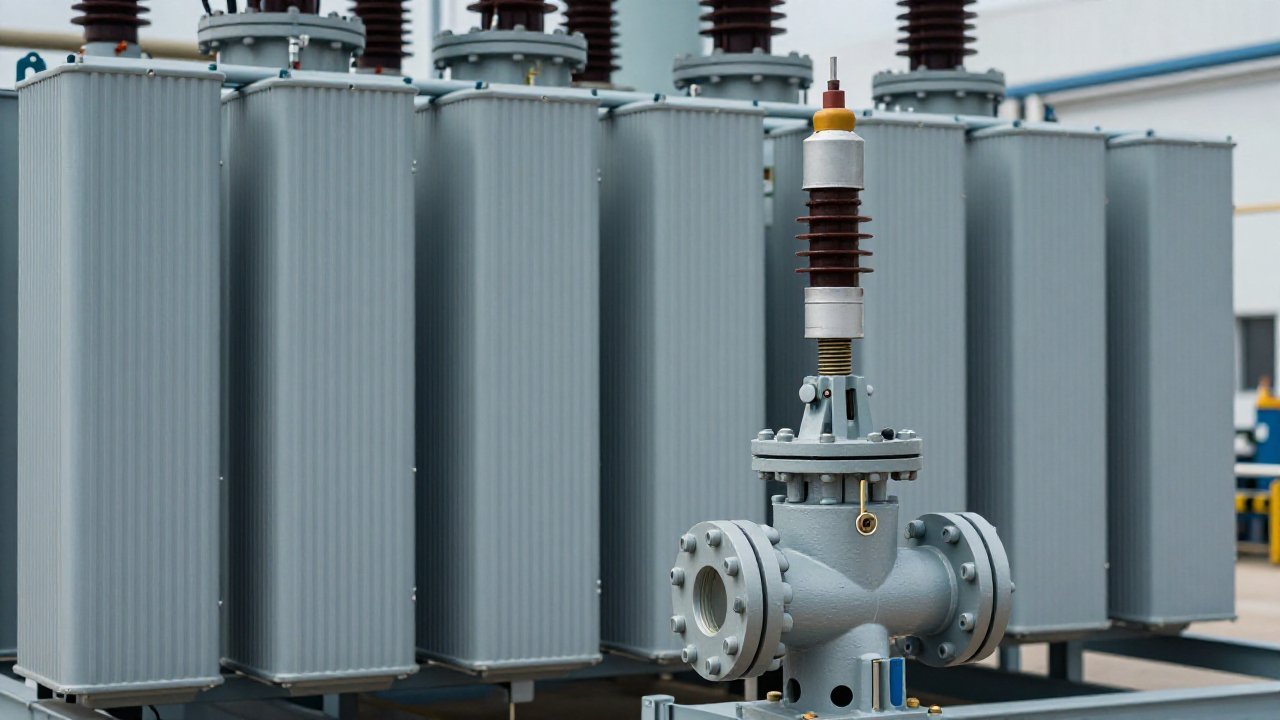
A paper posted to MDPI Electronics on 24 September 2026 described a risk-controlled classifier for dissolved gas analysis (DGA) that returns a credibility estimate with every fault diagnosis and runs in a median 0.713 ms on a CPU. The useful word in that title is “risk-controlled”: the method weighs a wrong answer by what the wrong answer costs. That is the discipline reliability-based DGA applies one step earlier — deciding which transformers deserve continuous gas monitoring at all.
Most fleets never make that decision explicitly: they inherit a spreadsheet and a vendor shortlist, then instrument whichever units are largest or loudest. A reliability-based DGA scope replaces the spreadsheet with a ranking that decides how many units are instrumented and which gas each is watched for.
Why Nameplate Rating Is the Wrong Sort Key
A 240 MVA transformer with a spare in the yard is a smaller risk than a 40 MVA unit whose failure strands a rail feeder or a data hall. Nameplate rating measures the size of the asset, not the size of the consequence. Reliability-based DGA starts from the consequence and works back to the instrument.
Four Inputs to a Reliability-Based DGA Scope
| Input | Question it answers | What it decides |
|---|---|---|
| Failure consequence | If this unit fails today, what stops? | Continuous monitoring or a sampling visit |
| Warning lead time | How fast does the expected failure mode develop? | Required measurement cycle and gas set |
| First-rising gas | Which gas moves first for that failure mode? | Whether hydrogen screening alone is sufficient |
| Site access | Can a crew reach the unit, and how often? | Whether a sampling programme is realistic |
Only the second input is a property of the transformer; the rest belong to the system around it. That is why a scope assembled from datasheets over-instruments the wrong units and under-protects the ones that matter.
Screening Many, Watching Few
A tiered scope falls out of the ranking. The top units get multi-gas analysis with moisture. The middle band gets a hydrogen channel, because hydrogen rises early in most incipient faults and a single-gas device costs a fraction of a multi-gas platform. The long tail stays on periodic laboratory DGA. That split is what makes the programme affordable: nine-gas instrumentation on every unit is not a realistic budget, and hydrogen screening on every unit often is.
Tiering only works if the tiers speak one language: whatever is installed must produce numbers comparable to the laboratory’s. The interpretation end of that chain is in the Duval triangle guide, and keeping trend records readable to operations is what monitoring software has to do.
How do you screen a fleet without buying 200 multi-gas monitors?
By separating the screening gas from the diagnostic gas set. Hydrogen is the earliest and most general indicator of an incipient fault, so a hydrogen-only channel on many units answers one question: is anything starting? Multi-gas analysis is then reserved for the units that answer yes, plus the few whose consequence ranking is high enough to skip screening. Fleet architecture and shared-analyser trade-offs are in DGA monitoring for transformer fleets.
What does reliability-based DGA change about alarm intervals?
Intervals stop being a fixed calendar and become a function of condition. IEEE C57.104-2019 formalises that shift through Condition 1 to Condition 4 ratings, stepping from an annual re-test down to daily or continuous monitoring as gas levels and generation rates rise. A reliability-based scope decides in advance which units can reach the continuous end of that ladder. Loading also moves gas behaviour, so the reference is the unit’s own history, not a fleet-wide table — how gases form in service is in DGA fundamentals.
PAS DGA for Reliability-Based Transformer Monitoring
The screening tier is where a hydrogen sensor earns its place. The DGA-500 monitor covers 5 to 5,000 ppm hydrogen with a 5 ppm detection limit over −40 to 105 °C, and the DGA-300 probe covers 2 to 2,000 ppm at ±20% or ±2 ppm; both place a palladium alloy element directly in the oil, with no membrane and no oil-to-gas path, and are verified against offline DGA to ASTM D3612, with recalibration only where deviation exceeds 15% (vendor data).
At the top of the ranking, DGA-900 adds the full nine gases plus moisture for units where a fault type has to be named rather than merely detected. Continuous data is judged on the same terms as laboratory data — IEC 60599:2022 for fault typing, IEC 60567 for measurement practice, IEEE C57.104-2019 for condition rating — with the framework collected under technology standards. The hydrogen sensor family covers standalone and OEM duty, and the compliance basis for the element itself is in dissolved hydrogen sensor compliance. Send your fleet list with unit ratings, loading and spares position to our engineering team for a tier proposal.
Sources
- “Risk-Controlled Adaptive-Resolution Fault Diagnosis of Power Transformers Using Dissolved Gas Analysis,” Electronics (MDPI) 2026, 15(19), 4404; median CPU-only latency 0.713 ms (research paper, 24 September 2026).
- IEEE Std C57.104-2019 — Condition 1–4 ratings and re-test intervals.
- IEC 60599:2022 (six fault types PD/D1/D2/T1/T2/T3); IEC 60567 (sampling and gas extraction).
- M. Duval, comparison of 122 cases from the IEC TC 10 database (research comparison; independent academic benchmarks report lower figures).
- Fleet-age statistic cited in the PAS DGA white paper: ≈70% of US power transformers have been in service more than 25 years.
- Asia-Pacific DGA analyzer market: ≈USD 0.25 bn (2024) to ≈USD 0.50 bn (2033), CAGR ≈7% (market report).
- PAS DGA hydrogen sensor product data, DGA-300 and DGA-500 (vendor data), 26 September 2026.