
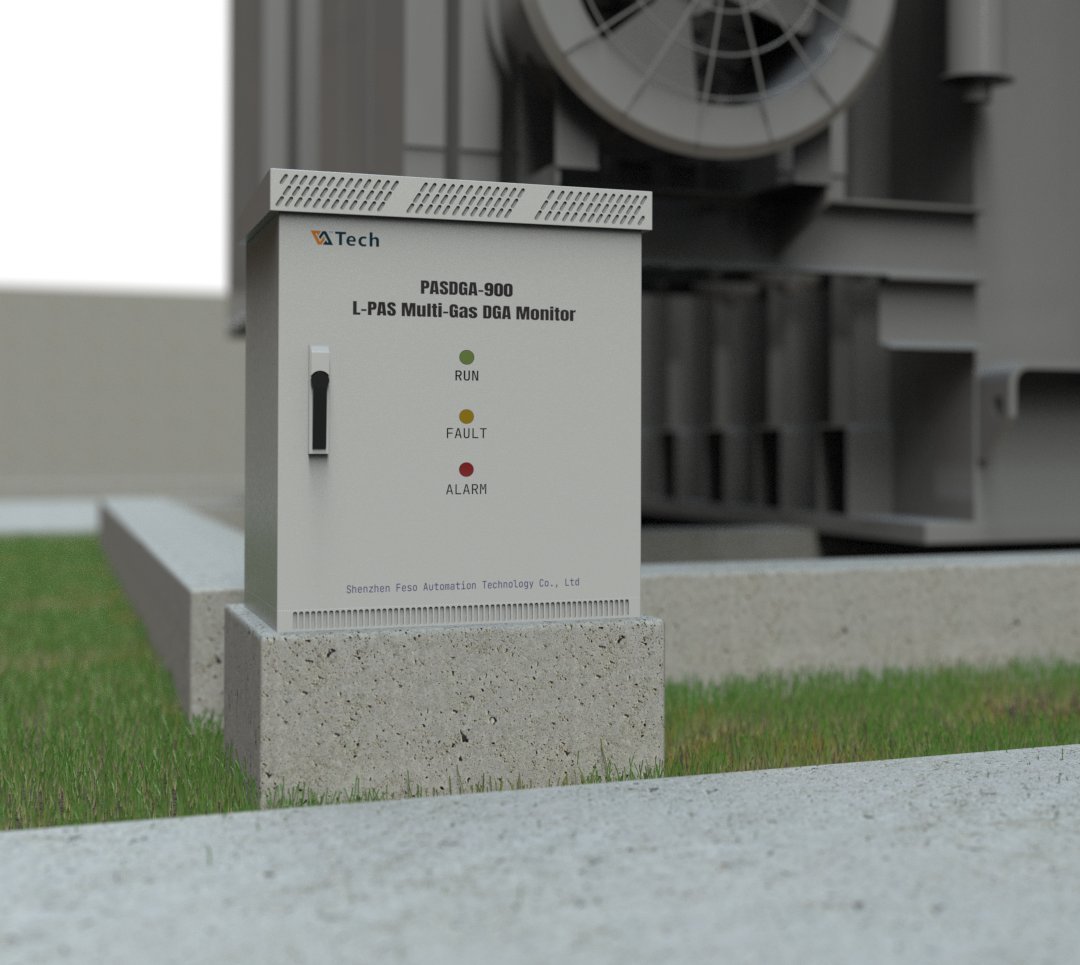
DGA-900 — Laser Photoacoustic Spectroscopy Multi-Gas DGA Monitor
Laboratory-grade dissolved gas analysis in real time. 9 fault gases + moisture via Laser Photoacoustic Spectroscopy (L-PAS). Deployed in China’s largest 1000 kV UHV substations and ±800 kV HVDC converter stations. The definitive online DGA solution for the world’s most critical power transformers.
L-PAS Technology
Gas Specifications
Configuration Modes
Software Suite
Technical Specs
Deployments
vs Hydrogen Sensors
Get a Quote
Product Overview
The DGA-900 is a cutting-edge online Dissolved Gas Analysis (DGA) monitoring system powered by Laser Photoacoustic Spectroscopy (L-PAS) — delivering the multi-gas analytical depth of laboratory gas chromatography with the real-time continuous monitoring of an online system. It detects and quantifies 9 fault gases plus moisture in transformer oil.
At its heart is a semiconductor laser with a spectral line width far narrower than the gas absorption lines. This ultra-narrow line width aligns precisely with each gas’s characteristic absorption line, achieving virtually zero cross-interference — a fundamental advantage over conventional broadband IR photoacoustic spectroscopy.
The system employs a vacuum-assisted membrane extraction that extracts dissolved gases without oil consumption, and complies with IEEE C57.104 and IEC 60599. Its embedded diagnostic engine runs Duval Triangle, Rogers Ratio, and Doernenburg analyses onboard, providing 72-hour early warning for incipient faults.
Key Specifications at a Glance
| Technology | Laser Photoacoustic Spectroscopy (L-PAS) |
| Gas Detection | 9 gases + moisture |
| H₂ LDL | 2 ppm |
| C₂H₂ LDL | 0.1 ppm |
| Communication | IEC 61850, MODBUS RTU (RS-485) |
| Diagnostics | Duval Triangle, Rogers Ratio, Doernenburg |
| Oil Consumption | Zero (vacuum extraction) |
| Enclosure | IP55, 630×660×870 mm |
| Warranty | Comprehensive — terms per product and contract |
L-PAS Technology — Why Laser?
L-PAS: Sub-GHz Line Width
The semiconductor laser source has a spectral line width far narrower than the gas absorption lines — narrower than the absorption lines of individual gas molecules. The laser can be precisely tuned to each target gas without exciting neighboring species, giving virtually zero cross-interference even for closely spaced bands like C₂H₄ and C₂H₆.
Classic-PAS: Broadband Limitation
Conventional broadband IR-PAS uses a wide-spectrum source with optical filters. Even the best filters have bandwidths of tens of nanometers — thousands of times wider than gas absorption lines — causing cross-interference and compensation algorithms that drift over time.
The L-PAS Advantage: 5 Key Benefits
1. Zero Cross-Interference — Laser matches single gas absorption lines. No filter drift, no compensation needed.
2. Higher Sensitivity — Concentrated energy at the target wavelength → stronger signal → 0.1 ppm C₂H₂ detection.
3. Superior Long-Term Stability — No optical filter degradation. Factory calibration holds for years.
4. Wider Dynamic Range — From a 0.1 ppm C₂H₂ trace-detection floor upward across the full fault-gas concentration range.
5. No Consumables — No carrier gas, no columns, no flame ionization detector. Laser source designed for long-term continuous operation with no consumables.
Gas Detection Specifications
The DGA-900 detects and quantifies all key fault gases identified in IEC 60599 and IEEE C57.104, plus oxygen and nitrogen for complete oil condition assessment. The table lists each gas’s guaranteed lower detection limit (LDL); upper measurement ranges are configured per customer requirement.
| Gas | LDL | Accuracy | Repeatability | Fault Indication |
|---|---|---|---|---|
| H₂ — Hydrogen | 2 ppm | ±8% | <3% | Partial discharge, arcing, thermal faults |
| O₂ — Oxygen | 200 ppm | ±3% | <3% | Seal integrity, oil oxidation |
| CO — Carbon Monoxide | 20 ppm | ±5% | <3% | Paper/cellulose thermal degradation |
| CO₂ — Carbon Dioxide | 20 ppm | ±5% | <3% | Paper/cellulose thermal degradation |
| CH₄ — Methane | 0.5 ppm | ±8% | <3% | Oil thermal fault (low-temp hot spot) |
| C₂H₂ — Acetylene | 0.1 ppm | ±5% | <3% | Arcing (key gas — most critical indicator) |
| C₂H₄ — Ethylene | 0.5 ppm | ±8% | <3% | Oil thermal fault (high-temp hot spot) |
| C₂H₆ — Ethane | 0.5 ppm | ±8% | <3% | Oil thermal fault (medium-temp) |
| N₂ — Nitrogen | 1,000 ppm | ±3% | <3% | Inert gas blanket integrity |
| H₂O — Moisture | 0–100% AW / 0–100 ppm | ±3% | <3% | Seal integrity, oil quality |
Three Configuration Modes
The DGA-900 is available in three configurations tailored to different deployment scenarios and integration requirements — from OEM module supply to fully integrated turnkey systems.
Module Only
For system integrators and monitoring platform manufacturers. You provide the enclosure and assembly — we provide the L-PAS core.
- L-PAS degassing module (vacuum-assisted)
- Full 9-gas + moisture detection module
- Photoacoustic cell (1 mL)
- Semiconductor laser source
- Communication module (IEC 61850 / MODBUS)
- Enclosure drawings + assembly guidelines
- Factory test report for each module
- OEM/ODM private-label ready
Standard System
Turnkey solution for substation deployment. Fully assembled, factory-tested, and calibrated. Ready to connect to the transformer oil valve and power.
- Everything in Module Only, plus:
- IP55 weatherproof enclosure (630×660×870 mm)
- Integrated air conditioning for enclosure
- Full installation and commissioning support
- 4-tier hierarchical alarm system
- Advanced data management software suite
- Multi-format data export (Excel, CSV, PDF)
- Automatic scheduled data logging
- Bidirectional remote communication
- On-site service available
Premium System
For the most critical assets — UHV substations, nuclear power plants, and HVDC converter stations — with extended service coverage and premium support.
- Everything in Standard System, plus:
- Automatic cloud synchronization option
- Extended service coverage (options per contract)
- Priority on-site service
- Custom gas range calibration
- Dual redundant communication paths
- Enhanced cybersecurity package
- Dedicated technical account manager
- Quarterly health check reports
- Free software updates for life
Software Suite & Diagnostics
The DGA-900 includes a comprehensive PC software package for configuration, monitoring, and diagnostic analysis — all running on standard Windows workstations in the control room.
Individual Gas Parameterization
Custom alarm thresholds, measurement ranges, and sampling intervals for each gas species independently.
Embedded Fault Analysis Engines
Duval Triangle 1 (IEC 60599), Rogers Ratio 3D visualization, and Doernenburg Method running onboard.
Enterprise Data Management
Unlimited historical storage with cloud sync. Export to Excel, CSV for SCADA, and PDF reports.
4-Tier Alarm System
Attention (50%) → Warning (80%) → Critical (100%) → Emergency (120%), configurable per gas with email, SMS, relay, SCADA.
Bidirectional Communication
IEC 61850 MMS/GOOSE and MODBUS RTU (RS-485, up to 1 Mbps, 32-node daisy chain).
Automated Scheduled Logging
From continuous sub-minute sampling during faults to hourly logging during steady state — all timestamped and stored.
Full Technical Specifications
Measurement System
| Technology | Laser Photoacoustic Spectroscopy (L-PAS) |
| Laser Line Width | Sub-GHz (DFB) |
| Degassing | Vacuum-assisted membrane (zero oil consumption) |
| Photoacoustic Cell | 1 mL volume |
| Gases Detected | H₂, O₂, CO, CO₂, CH₄, C₂H₂, C₂H₄, C₂H₆, N₂, H₂O |
| Measurement Accuracy | Min detection limit or ±20% (whichever is greater) |
| Sampling Interval | Configurable, 1 min minimum |
| Oil Temperature Range | 10 to 100°C |
System & Environmental
| Power Supply | AC 210–240V, 50/60 Hz, 2 kW |
| Ambient Temperature | -40 to 55°C (-10 to 55°C when starting) |
| Humidity | 10–95% RH, non-condensing |
| Enclosure Rating | IP55 |
| Dimensions | 630 (W) × 660 (D) × 870 (H) mm |
| Weight | <150 kg |
| Communication | IEC 61850, MODBUS RTU (RS-485/232) |
| Warranty | Comprehensive — terms per product and contract |
Proven at the Highest Levels
Deployed across China’s most critical power infrastructure — from 1000 kV UHV AC substations to ±800 kV HVDC converter stations, nuclear power plants, and major hydropower facilities.
Nuclear Power
Nuclear power plants — continuous DGA for critical GSU and station service transformers.
1000 kV UHV AC
Transmission and substation transformers on China’s UHV AC backbone.
±800 kV HVDC
Converter transformer monitoring on HVDC links.
Hydropower Plants
Jiangxi Wan’an, Hunan Dongjiang — GSU transformer monitoring at major hydroelectric stations.
750 kV Substations
Northwest China grid backbone.
500 kV Regional Grid
Huizhou Goose City, Hubei Mulan, Liaoning Dandong — regional transmission hub substations.
DGA-900 vs Hydrogen Sensors — Complementary Solutions
When to Choose Hydrogen Sensors
The PAS DGA hydrogen sensor series (DGA-200/300/500) is ideal for fleet-wide deployment — distribution transformers, industrial plants, and any application where hydrogen trending alone provides sufficient early warning. Lower acquisition cost, zero maintenance, valve-mount installation in under an hour. Hydrogen is the universal fault indicator, generated in every transformer fault type.
Where hydrogen trending alone is not enough but a full 9-gas monitor is more than the asset justifies, the DGA-700 compact multi-gas monitor adds CO and moisture in a single valve-mount package — the middle rung between the hydrogen sensor series and the DGA-900.
When to Choose DGA-900
The DGA-900 is the choice for critical assets where comprehensive diagnostics are mandatory — transmission-class transformers (≥220 kV), GSU transformers at power plants, HVDC converter transformers, and nuclear facility transformers. When you need full gas speciation for precise fault-type identification, or when regulatory compliance mandates multi-gas DGA, the DGA-900 delivers laboratory-grade analysis in real time.
Interested in the DGA-900 Multi-Gas Monitor?
Request pricing, availability, or technical specifications. Our team responds within 1 business day.
Explore DGA Technology & Applications
DGA-700 Compact Multi-Gas Monitor
How PAS Works
Pd Thin-Film Sensor Technology
DGA Technology Comparison
DGA Fundamentals
DGA Diagnostic Methods
Fault Types & Gas Signatures
Hydrogen vs Multi-Gas DGA
Online vs Offline DGA
Duval Triangle Method
DGA Standards & Certifications
Power Utility Applications
HVDC & UHV Applications
L-PAS DGA White Paper
Image credits: Wikimedia Commons (CC BY-SA) — placeholder photography. Product photographs and detailed specifications available on request.
How to install and commission the DGA-900
- Step 1: Connect to the valve — mount the monitor and attach it to the transformer sampling valve with the included universal valve adapter kit (DN15–DN32).
- Step 2: Close the oil loop — connect the return line so oil circulates back to the transformer.
- Step 3: Power on — the monitor runs its self-check and begins circulating oil.
- Step 4: Configure — set the output protocol (MODBUS RTU or IEC 61850) and the measurement interval.
- Step 5: Verify the first report — confirm the first multi-gas plus moisture reading matches the expected oil condition.
FAQ
Q: Can DGA-900 be retrofitted to existing transformers?
A: Yes. The DGA-900 installs on any standard transformer sampling valve via the included universal valve adapter kit (DN15–DN32).
Q: Can I integrate DGA data with my existing SCADA?
A: Yes. The DGA-900 supports IEC 61850 (MMS and GOOSE) for integration with digital substations.
Q: How does the DGA-900 differ from the DGA-500?
A: The DGA-500 is a dissolved-hydrogen sensor — one gas, one number. Its job is early warning and fleet-wide coverage at low cost, and hydrogen is generated in every fault type, so it will tell you that something is developing. The DGA-900 is a multi-gas monitor: it reports the individual fault gases plus moisture, which is what lets it separate a thermal fault from partial discharge from arcing, and it is the unit to choose where a wrong diagnosis is expensive.
Q: Is the DGA-900 the same instrument as a Kelman DGA 900, a Megger InsuLogix G2 or a “DGA 1005”?
A: No. Those are separate products from other manufacturers, and the similar model numbers are a coincidence of this market rather than a shared product family — if you are comparing quotations, confirm the manufacturer on the nameplate and the datasheet behind each offer. They also differ in what they measure. Megger’s InsuLogix G2 covers acetylene, hydrogen and moisture using tunable diode laser spectroscopy; GE Vernova’s Kelman DGA 900 covers nine gases plus moisture using photo-acoustic spectroscopy, the same measurement principle this monitor family is built on; the HYDROCAL 1005 reports hydrogen, carbon monoxide, acetylene, ethylene and moisture (vendor data). When you compare online multi-gas monitors, four questions actually change the answer: which gases are measured individually, how often a complete reading is produced, how the unit is verified after installation, and what cross-sensitivity figures the vendor publishes.
Sources: Megger, InsuLogix G2 product page, megger.com (accessed 2026-09-16); GE Vernova, Kelman DGA 900 brochure, doc. 1599-202410-A4, 2024 (vendor data); HYDROCAL 1005 specifications as tabulated in “Dissolved Gas Analysis Equipment for Online Monitoring of Transformer Oil: A Review”, Sensors (MDPI), PMC6806153 (vendor data).