
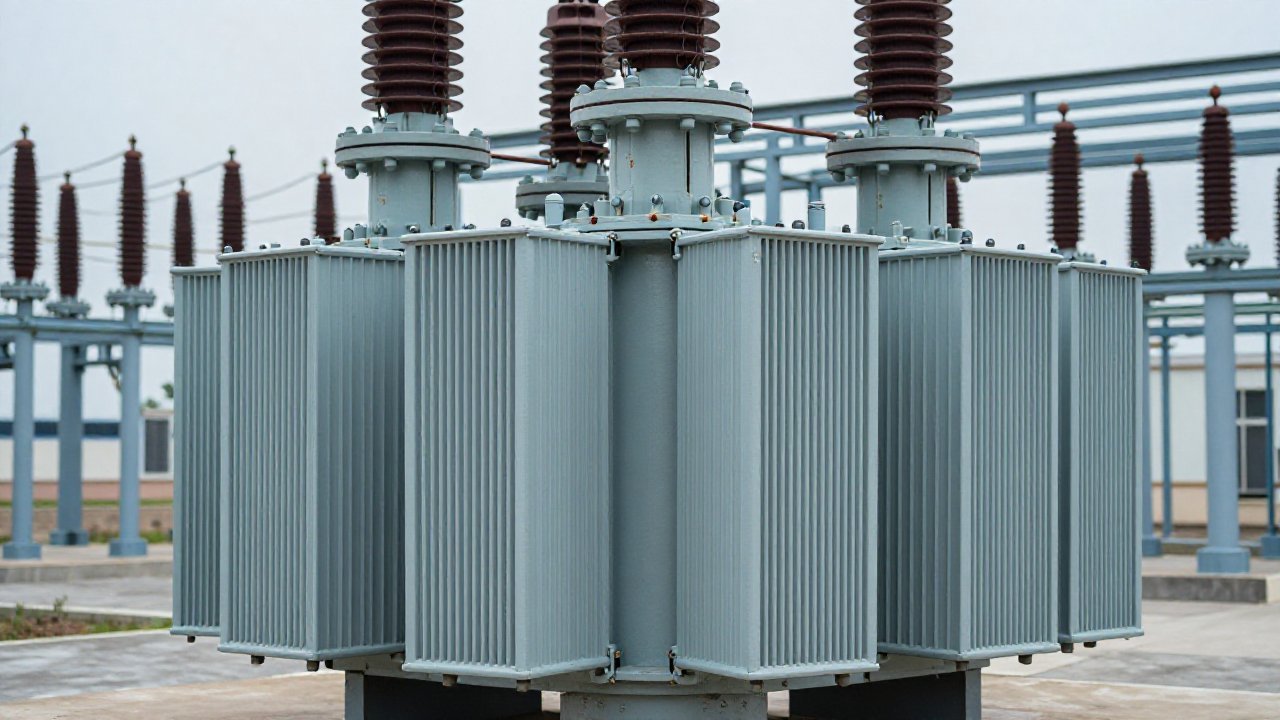
On 27 March 2026 Standards Australia published AS/NZS IEC 60270:2026, adopting the fourth edition of the conventional partial discharge (PD) standard, retitled Charge-based measurement of partial discharges; the CENELEC equivalent, EN IEC 60270:2025, takes national effect on 31 August 2026. The same year the standard for the measurement methods that travel without coupling devices, IEC TS 62478, entered revision. The timing is a useful prompt to restate something engineers rediscover every campaign: offline PD testing measures a circuit as much as it measures a transformer.
In a conventional offline test the unit is de-energised, a test voltage is applied, and the discharge current is read through a measuring impedance coupled to the test circuit. The value recorded is apparent charge in picocoulombs (pC), and it is defined for that circuit — the coupling capacitance, the impedance, the calibration injection point and the lead layout all sit inside the definition. Change the circuit and the same defect returns a different number.
What Sets the Number in Offline PD Testing
| Variable | Effect on the recorded value |
|---|---|
| Coupling capacitance | Sets the high-frequency path the discharge current takes; a different coupler is a different measurement |
| Measuring impedance | Determines the voltage the detector sees, and over what bandwidth |
| Calibration injection point | Defines the pC scale; inject elsewhere and the scale moves with it |
| Test leads and terminations | Add stray capacitance and inductance that reshape the pulse |
| Background noise gate | Decides which pulses are counted at all |
This is why IEC 60270 has always been as much a standard for calibrating and qualifying the measuring system as for the object under test. The fourth edition tightens that end of the document: it treats measurement as charge-based, applies to alternating voltages up to 500 Hz or to direct voltage, and adds a normative annex for checking the performance of calibrators.
What Offline PD Testing Proves — and What It Cannot
An offline test earns its place on three things it does well. It reads a defect with the plant quiet, so the noise gate can be set low. It produces a calibrated pC figure on which a pass/fail judgement or a baseline is defensible. And it covers the winding in a defined way, because the applied voltage and the gate are chosen rather than inherited. None of that makes the figure a property of the transformer: two laboratories testing the same unit through two different circuits will produce two honest, different numbers, and neither is wrong.
The larger limitation is what offline testing cannot sample: it captures minutes of behaviour, at a voltage and thermal state the unit does not normally run at, with no load and no switching transient. PD activity responds to voltage, load and temperature, so an intermittent defect can stay silent for the whole test window. The portable-versus-fixed trade-off on real sites is set out in PD testing system field constraints.
When the Coupling Devices Come Off
The methods that do not need a coupling capacitor — ultra-high-frequency (UHF), high-frequency current transformer (HFCT) and acoustic sensing — are covered by IEC TS 62478, adopted identically as GB/T 42287, with DL/T 1498.1 governing online monitoring devices as a class. They read electromagnetic or acoustic energy rather than charge, they report in decibels or millivolts, and no honest conversion factor turns one of those readings into the pC figure from an offline test. IEEE Std C57.127 addresses acoustic detection only and cannot be used to justify a UHF or HFCT channel. None of these documents type-tests an instrument: “designed to IEC TS 62478” describes a method, not a certificate. The layering is collected under technology standards.
Does offline PD testing need the transformer to be offline?
Conventional charge-based testing does, because the test voltage and the coupling arrangement are built around a de-energised unit. The non-conventional methods can run whenever the unit is energised, which is their main advantage: a drain-valve UHF coupler or an HFCT on the earth connection reads the defect under real load rather than under a test voltage. The two approaches answer different questions and are usually run together.
Can an online PD monitor’s reading be converted to picocoulombs?
Not honestly, across circuits. A UHF or HFCT channel has no calibrated charge reference, so its reading is anchored to its own sensor and its own installation — which is why an alarm should trigger on departure from a unit’s own baseline rather than on an absolute pC figure. The comparison between the two families is in online versus offline PD testing, and the fleet-level picture at utility scale is in PD monitoring for power utilities.
PAS DGA for PD Measurement Without the Coupling Device
The TPD-400 is a permanent monitoring IED with four sensing inputs: UHF couplers (300–1500 MHz, oil valve or manhole), HFCT (0.3–30 MHz, earth connection), acoustic sensors (80–200 kHz, tank wall) and radio-frequency sensing. It samples at 125 MS/s with 14-bit resolution, synchronises channels to better than 100 ns, resolves apparent charge to roughly 5 pC, withstands 600 kV lightning impulse on the sensing path, and runs from an AC 220 V local cabinet over −30 to 60 °C (vendor data). It communicates over IEC 61850 (DL/T 860) and Modbus, and is designed in line with IEC TS 62478 / GB/T 42287 and DL/T 1498.1.
Because those channels observe one defect through different physics, the output that survives without a PD specialist on shift is the cross-channel comparison (PD versus DGA). On the gas side, DGA-900 adds nine-gas and moisture analysis for units where the fault type has to be named. The channel plan and cabinet requirements are in the product manuals. Tell us the unit ratings and the ports available on site and we will return a channel plan — contact us with your transformer details.
Sources
- AS/NZS IEC 60270:2026, High-voltage test techniques — Charge-based measurement of partial discharges, Standards Australia, published 27 March 2026 (63 pp., ISBN 978 1 76175 692 4).
- IEC 60270:2025 (Ed. 4.0), published 5 June 2025; cancels and replaces the third edition (2000) and Amendment 1:2015; charge-based measurement, AC up to 500 Hz or DC, normative annex for calibrator performance tests. CENELEC EN IEC 60270:2025, national implementation date 31 August 2026.
- IEC TS 62478:2016, Measurement of partial discharges by electromagnetic and acoustic methods (= GB/T 42287); Edition 2 in development, no publication date set as at September 2026.
- DL/T 1498.1, online monitoring devices; IEEE Std C57.127-2018, acoustic detection only; IEEE Std C57.113-2023.
- TPD-400 technical data, pasdga.com/products/tpd-400/, accessed 29 September 2026 (vendor data).