
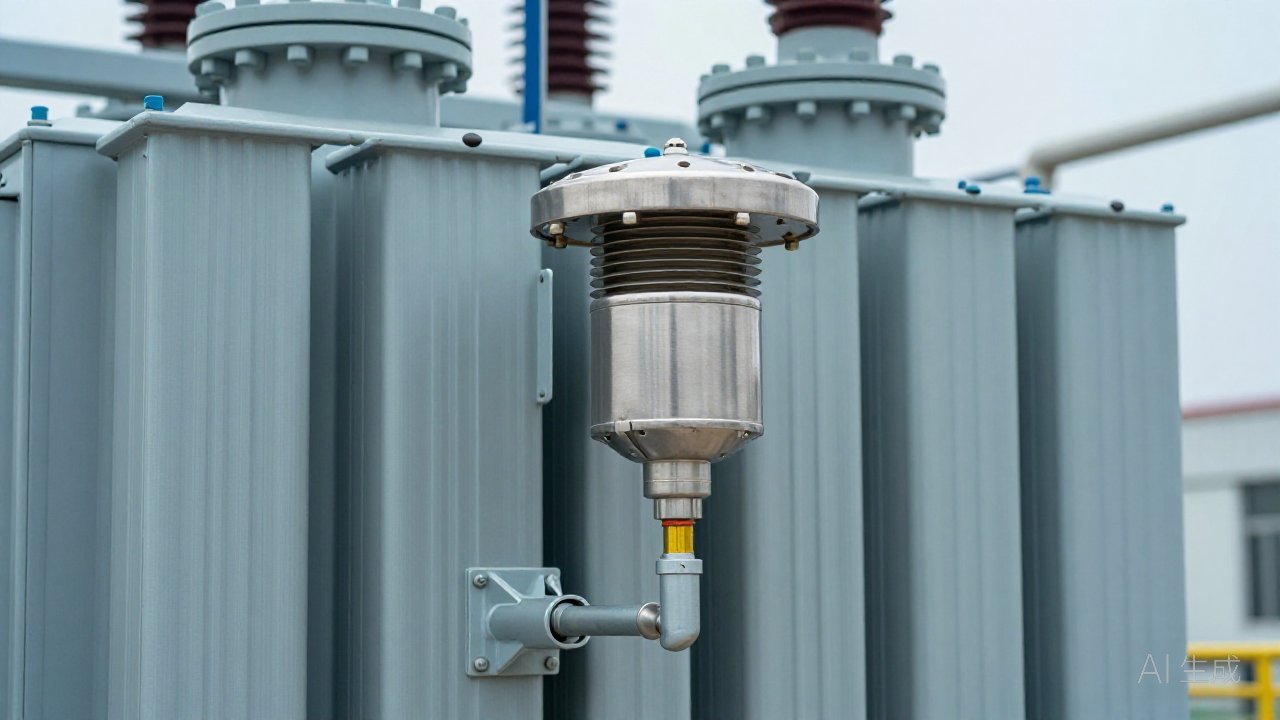
On 12 November 2026, TY Data valued the global transformer dissolved gas analysis (DGA) analyzer market at US$587 million for 2025, rising to US$896 million by 2032 (vendor data), and split the product list in two: single-gas and multi-gas. That same week, Elia Transmission Belgium confirmed that its larger transformers now carry continuous monitors, adopted after a twelve-month trial. Both announcements use the phrase multigas measurement for instruments that do not report the same thing. What decides whether a reading is worth acting on is which numbers the instrument senses directly, which it calculates, and which fault-diagnosis methods still run on the list it delivers.
What a multigas measurement actually contains
A nine-gas report is rarely nine sensing channels. Hydrogen, oxygen and nitrogen have no useful infrared absorption, so they are read on auxiliary thermal-conductivity channels, not in the optical path. Moisture is a separate capacitive sensor sampling the same oil. Some instruments report total combustible gas as a single number with no per-gas breakdown — enough for a trip alarm, not enough for a diagnosis. Two nine-gas datasheets placed side by side look identical until one states, gas by gas, measured or derived.
The five-gas floor a verdict needs
IEC 60599:2022 judges six fault types — partial discharge, D1, D2, and thermal faults T1 to T3 — from gas ratios and from the Duval triangle. The triangle needs three gases: methane, ethylene and acetylene. The ratio schemes need five: hydrogen, methane, ethane, ethylene and acetylene. That is the quiet cliff inside a multigas measurement. An instrument that omits ethane cannot run IEC or Rogers ratios at all, and the operator falls back to key-gas interpretation — roughly 42% agreement in research comparisons against the IEC TC 10 fault database, against about 62% for Rogers ratios and about 95% in Duval’s own 122-case comparison, with independent academic benchmarks lower at 65–87%. An eight-gas monitor without ethane is not a cheaper nine-gas monitor. It is a different diagnostic instrument wearing the same label.
| Gas | Direct role in a verdict | What is lost without it |
|---|---|---|
| H₂ | Earliest signal of most fault types | Warning time and discharge sensitivity |
| CH₄ | Duval input; thermal zones | Triangle cannot be plotted |
| C₂H₄ | Thermal severity, T1 to T3 | Overheating cannot be graded |
| C₂H₆ | IEC and Rogers ratio input | Ratio schemes unavailable |
| C₂H₂ | Separates discharge from overheating | Arcing looks like a hot spot |
| CO / CO₂ | Cellulose (paper) involvement | Paper fault looks like oil fault |
| O₂ / N₂ | Not diagnostic; air-ingress check | N₂:O₂ near 3.7 read as a fault |
Where the numbers drift after commissioning
The accuracy of an installed monitor is set by the oil-to-gas stage and the calibration chain, not by the light source. A 2024 comparison by Grisaru in Transformers Magazine 11(3):50–61 measured photoacoustic instruments at roughly 24% deviation against about 3% for headspace gas chromatography on 100 and 500 ppm standards — a research comparison. Degassing speed, membrane permeation and single-point calibration dominate the error budget, and behave differently per gas. Acetylene below 1 ppm is a different problem from methane at several hundred, so a multigas measurement quoting one response time and one accuracy figure across nine gases deserves a follow-up question.
Five questions that separate one datasheet from another
One: measured or derived, gas by gas? Two: the detection limit per gas, and against which standard? Three: the response time per gas — is it membrane-limited? Four: which ratio schemes does the delivered list support? Five: what is the calibration gas, and how often is zero and span re-established? A hydrogen-only sensor answers a narrower question honestly: the DGA-300 covers 2–2000 ppm with a 2 ppm limit of detection, and the DGA-500 covers 5–5000 ppm at 5 ppm (vendor data). Neither pretends to produce a Duval verdict — buy the instrument for the verdict it can defend.
Does multigas measurement always mean nine gases?
No. The count is a marketing convention. A unit reporting nine gases may sense six, derive two and read one on an auxiliary channel, or it may report nine individually calibrated values. Ask for a per-gas table stating channel type, detection limit, and whether the value is measured or calculated. Two instruments with the same headline number can differ by an entire diagnostic method.
Can I run a Duval triangle on a five-gas monitor?
The triangle uses methane, ethylene and acetylene, so three gases plot a point. The pentagon uses five — hydrogen, methane, ethane, ethylene and acetylene — across seven zones. Ratio methods need five, and without ethane they are unavailable. Below that floor only key-gas reasoning remains: useful for triage, weak for a written judgement.
PAS DGA builds hydrogen-only sensors and a nine-gas online monitor with moisture for fleets that need the complete ratio set. If you are comparing gas lists, send the datasheets and we will map measured against derived, channel by channel. Start at the dissolved hydrogen compliance hub or talk to an engineer.
Sources
- TY Data, transformer DGA analyzer market report, 12 November 2026 (vendor data).
- Elia Transmission Belgium, online DGA trial, November 2026.
- IEC 60599:2022, interpretation of dissolved and free gases.
- M. Duval, 122-case comparison, IEC TC 10 database; key-gas and Rogers figures from the same database (research comparison); academic benchmarks 65–87%.
- Grisaru, Transformers Magazine 11(3):50–61, 2024.