
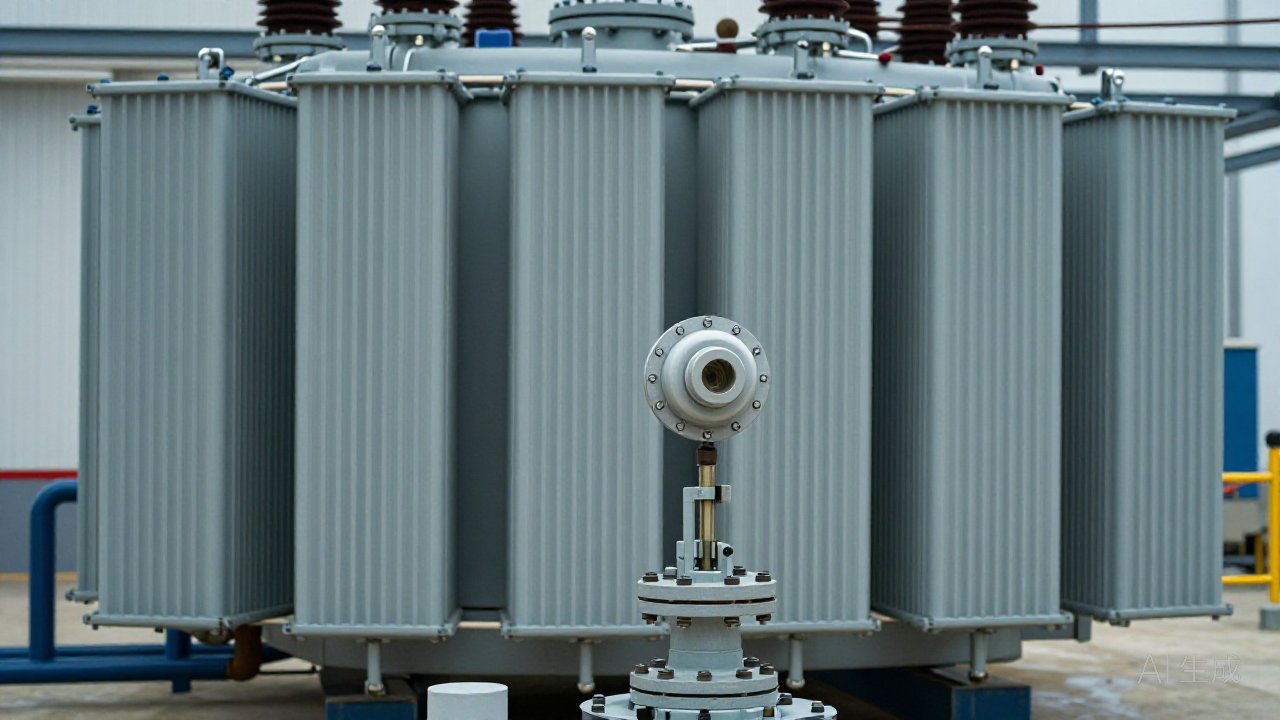
In August 2026 State Grid Jiangsu reported on-site verification capability covering six transformer online-monitoring categories — ultrasonic, high-frequency, UHF, vibration, core grounding current and bushing last-screen. The list points at the operational problem: a transformer condition monitoring system with several channels produces several alarms, and someone has to turn them into one decision.
What each channel contributes
PD and DGA answer different questions and fail in different ways. Partial discharge monitoring is an event counter: it sees discharge activity in real time and can localise a source when channels share a clock. Dissolved gas analysis is an integrator: it sees what the fault has left in the oil, which is what identifies the fault type. A system that only trends gas reacts late; a system that only watches pulses classifies poorly.
Hardware follows the same split. TPD-400 provides UHF, HFCT, acoustic and RF inputs with multi-channel synchronisation better than 100 ns and a minimum measurable apparent charge around 5 pC (vendor data). DGM-900 covers the gas side, with hydrogen sensors available where a single-gas channel is sufficient.
Stage 1: establish the baseline
The first weeks are for fingerprints, not alarms. Record PD level and repetition rate against load and temperature, note the noise floor at each coupler, and take a laboratory DGA and moisture sample as the chemical anchor. Without this step every later reading is compared with a generic threshold instead of with the unit itself — the difference between a system that reports change and one that reports opinion.
Stage 2: screen continuously
Daily screening compares each channel with its own baseline. For PD that means deviation in level and pulse repetition rate; for dissolved gas, rate of rise rather than absolute concentration. Rate matters because a slow climb from a stable baseline and a fast climb from the same baseline are different faults, and the second one rarely waits for the next quarterly sample. The treatment of both is set out in PD alarm thresholds and trending.
Stage 3: cross-trigger, then confirm
The value of a joint system sits in the rules between channels, not inside either one.
| Trigger | Immediate action | Confirmation |
|---|---|---|
| PD deviates upward | Re-trend over 24 hours; check for a new noise source | Oil sample within days; compare with the last lab result |
| Hydrogen or acetylene rises | Verify sensor and sampling point; check load history | Laboratory DGA and gas ratios |
| PD and gas rise together | Treat as an active fault; increase sampling frequency | Source localisation and an outage plan |
| Moisture rises with temperature | Check breathing equipment and oil processing history | Laboratory moisture and oil quality tests |
Two channels agreeing shortens the path to a decision. One channel alone should produce an inspection, not an outage — a distinction that protects both the asset and the maintenance budget.
Does a transformer condition monitoring system need both PD and DGA?
Not on every unit. A critical transmission transformer benefits from both because the two channels cover each other’s blind spots, while a distribution unit may run hydrogen-only and still catch the slow faults that matter at that voltage class. Where both are installed, they should share one timeline and one alarm policy; otherwise the operations team receives two unrelated stories about the same asset.
Which channel should raise the first alarm?
The faster one — normally PD or hydrogen. That choice should not make the other channel optional. The first alarm starts the investigation; the second channel is what turns an investigation into a diagnosis. The reasoning behind the pairing is covered in PD monitoring versus dissolved gas analysis, and the gas side is explained in DGA fundamentals.
A transformer condition monitoring system earns its cost at the moment two weak signals become one strong conclusion. TPD-400 is specified in line with IEC TS 62478 and GB/T 42287 for non-conventional PD measurement — a method statement, not a certificate — and pairs with the DGM-900 gas channel and hydrogen sensors where a staged build is preferred. To map the stages onto an existing fleet, send the transformer list and current monitoring setup.
Sources: State Grid Jiangsu on-site verification report covering six transformer online-monitoring categories, August 2026; Dynamic Ratings C50 PD+ launch at CIGRE 2026 (vendor announcement); IEC TS 62478:2016; IEC 60599.