
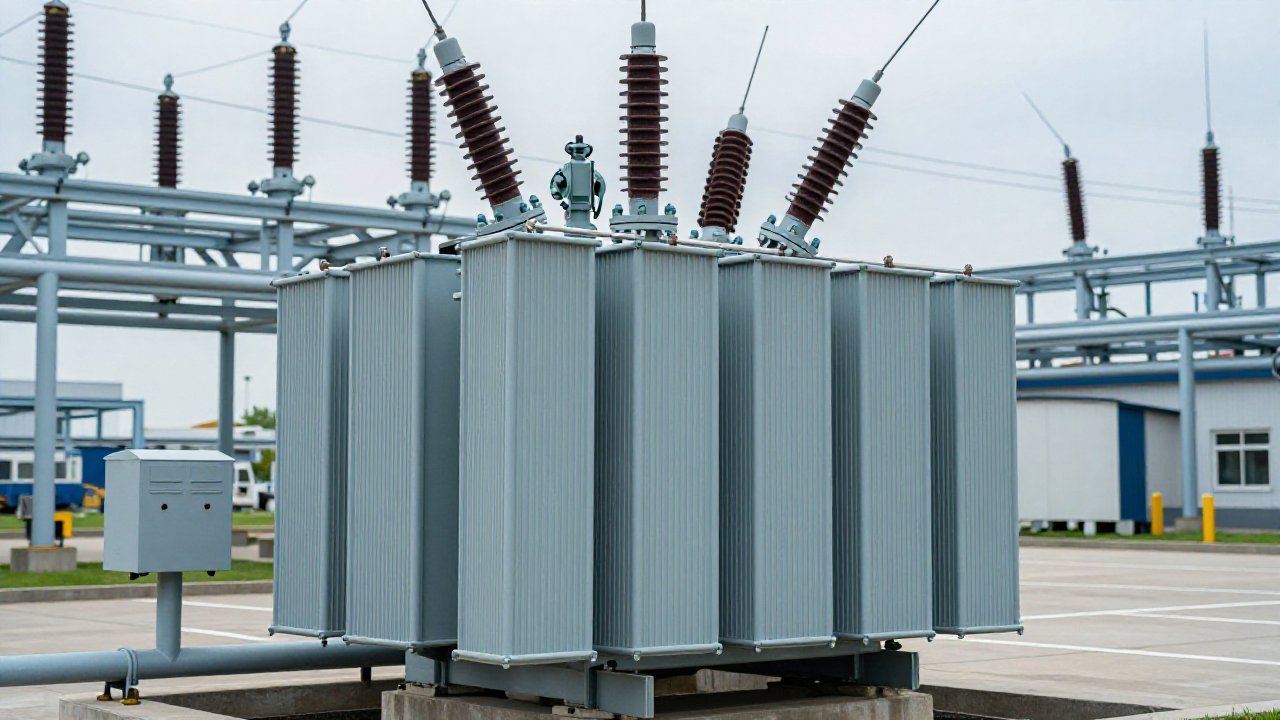
Converter transformers in HVDC stations work under a harder electrical duty than their AC cousins: DC voltage stress, harmonic currents and repeated energization transients all bear on the insulation system. When a converter transformer fails, the economic cost is measured in months of outage on a transmission corridor, not in a repair bill. Acetylene is the gas that gives early notice of the discharges and hot spots that precede such failures — but on converter transformers, the absolute reading can mislead. What tripped the units in the three anonymized records below was not a high number alone; it was a fast rate of rise, caught by continuous online acetylene monitoring at ±660 kV and ±800 kV stations.
Converter transformers fail differently — and C₂H₂ tells you first
Under DC and harmonic stress, partial discharge and sparking can develop inside a converter transformer with relatively little warning in other dissolved gases. Acetylene is their signature. Two properties make online C2H2 monitoring especially valuable on converter transformers: the values of interest are low (fractions of a µL/L at onset), and the development can be fast — fast enough that a monthly lab sample may simply miss the slope. A monitor that measures at sub-0.1 µL/L sensitivity on a cycle of tens of minutes turns “some acetylene appeared” into a dated, quantified trend.
Three converter-station records at a glance
| Record | Asset | Key online reading | Decisive parameter | Outcome |
|---|---|---|---|---|
| A | ±800 kV pole low-end converter transformer, days after replacement | A/B/C phases: 0.86 / 1.22 / 1.22 µL/L | Unstable rising trend across all three phases | Matched lab to A1-class accuracy; bank held under watch |
| B | ±800 kV converter transformer (two prior destructive failures) | 0.07 µL/L detected ≈32 h before rapid climb to 0.3 µL/L | Advance warning time | Phase tripped on dispatch approval; internal PD found; a third failure avoided |
| C | ±660 kV converter transformer | 3.15 µL/L with weekly increment ≈2 µL/L | Weekly rate-of-rise reached the trip criterion | Unit shut down on schedule; post-trip lab 3.02 µL/L |
Case A — Recommissioned ±800 kV bank: erratic acetylene within days
A pole low-end converter transformer at an ±800 kV station was replaced, and the new bank was recommissioned in mid-November 2023. Five days later, acetylene on all three phases of that bank began to climb and the readings were not stable. On the following day the online monitors reported 0.86, 1.22 and 1.22 µL/L on phases A, B and C respectively — still low in absolute terms, but clearly moving.
The readings were cross-checked against laboratory chromatography and found to comply with the A1-class accuracy requirement used for online DGA acceptance. That gave the operator a defensible, documented baseline for a bank that had just been through a major replacement — precisely when the trend history of the asset had been reset to zero.
Case B — A unit that had already failed twice: 32 hours of warning
The most dramatic of the three records concerns an ±800 kV converter transformer that had already been destructively failed twice. Any recurrence carried an unusually high risk, and the operator was monitoring it continuously. In late December 2024 the online monitor caught acetylene at 0.07 µL/L — a trace close to the detection floor, and far below any conventional alarm. About 32 hours later, the gas climbed rapidly to 0.3 µL/L.
Because the trend had been documented from its very first micro-rise, the station operator had the evidence and the confidence to act immediately, and the phase was tripped with dispatch approval. Subsequent inspection found internal partial-discharge activity. The 32 hours between first detection and the fast climb were the entire decision window — a window that only a sensitive, continuously sampling monitor could have opened.
Case C — ±660 kV: the weekly increment reached its trip value
A converter transformer at a ±660 kV station had carried trace acetylene for a long period — a familiar, watch-and-wait situation. What changed in late June 2026 was the shape of the curve: the trace reading began to climb, and the climb kept steepening. On 7 July 2026 it reached 3.15 µL/L with a weekly increment of about 2 µL/L. That increment met the operator’s defined shutdown criterion, and the unit was taken out of service on schedule.
Two details make the record instructive. First, in the final two days before the shutdown no oil sample could be drawn — operational conditions closed the laboratory channel, and the online monitor was the only live signal available during exactly the period that mattered most. Second, oil taken after shutdown measured 3.02 µL/L against the monitor’s last reading of 3.15 µL/L — agreement to 0.13 µL/L at the trip point.
Reading acetylene trends in converter stations
- Rate-of-rise is the actionable parameter. Absolute acetylene in these records ranged from 0.07 to 3.15 µL/L — the common thread was not the level but the slope (Case C: ≈2 µL/L per week), or the sudden change in slope (Case B).
- Sampling continuity closes the gaps. Case C’s final two days and Case B’s 32-hour window are periods a periodic sampling program would simply have missed.
- Online accuracy makes the call defensible. A1-class agreement with the laboratory (Case A) and 0.13 µL/L agreement at the trip point (Case C) are what let an operator act on a machine’s number.
Q: Why does acetylene trend matter more than the level on converter transformers? A: Because normal operating stress can produce low background readings, while the dangerous condition is a discharge that accelerates. A weekly-increment criterion converts “the number is high” into “the number is doubling,” which is far more specific to an evolving fault.
Q: What sampling frequency is needed to catch a fast acetylene rise? A: The useful interval is far shorter than a month. In Case B the entire warning window was about 32 hours; a monitor cycling in tens of minutes is what made the first 0.07 µL/L reading visible in time.
Monitor your converter transformers the same way
The laser-photoacoustic platform behind these records detects acetylene down to 0.05 µL/L and can be configured for fast-cycle acetylene measurement on the units where risk is highest. Start with the DGA-900 product page, read the HVDC converter-transformer DGA guide for fleet strategy, and see how gas rate-of-rise is used in diagnosis for the method behind the weekly-increment rule. Contact PAS DGA to apply the same protection to your converter fleet.