
A New Mandate Puts Transformer Oil Under Continuous Watch
In July 2026, China’s National Energy Administration released a revised edition of the 25 Key Requirements for Preventing Power Production Accidents, making full-component online oil chromatography monitoring a mandatory requirement for transformers rated 220 kV and above. The change, reported on 7 August 2026, closes a long-standing gap: conventional offline dissolved gas analysis (DGA) samples oil every three to six months, and industry reporting puts 37% of sudden transformer failures developing to the accident stage between two offline test intervals. For utilities planning around-the-clock gas coverage, the practical question is which gas to watch first. The answer usually starts with the simplest one — dissolved hydrogen in transformer oil.
Why Hydrogen Moves First — and How Online Sensors Measure It
Hydrogen appears in almost every developing fault inside an oil-filled transformer. Partial discharge, low-temperature overheating, and moisture-related stress decompose the oil and generate H2 before heavier fault gases build up. Because the hydrogen molecule is the smallest in the gas mix, it diffuses fastest and reaches a sensor at the tank wall well before methane, ethylene, or acetylene — which is why it anchors the “key gas” method used in modern diagnostic workflows.
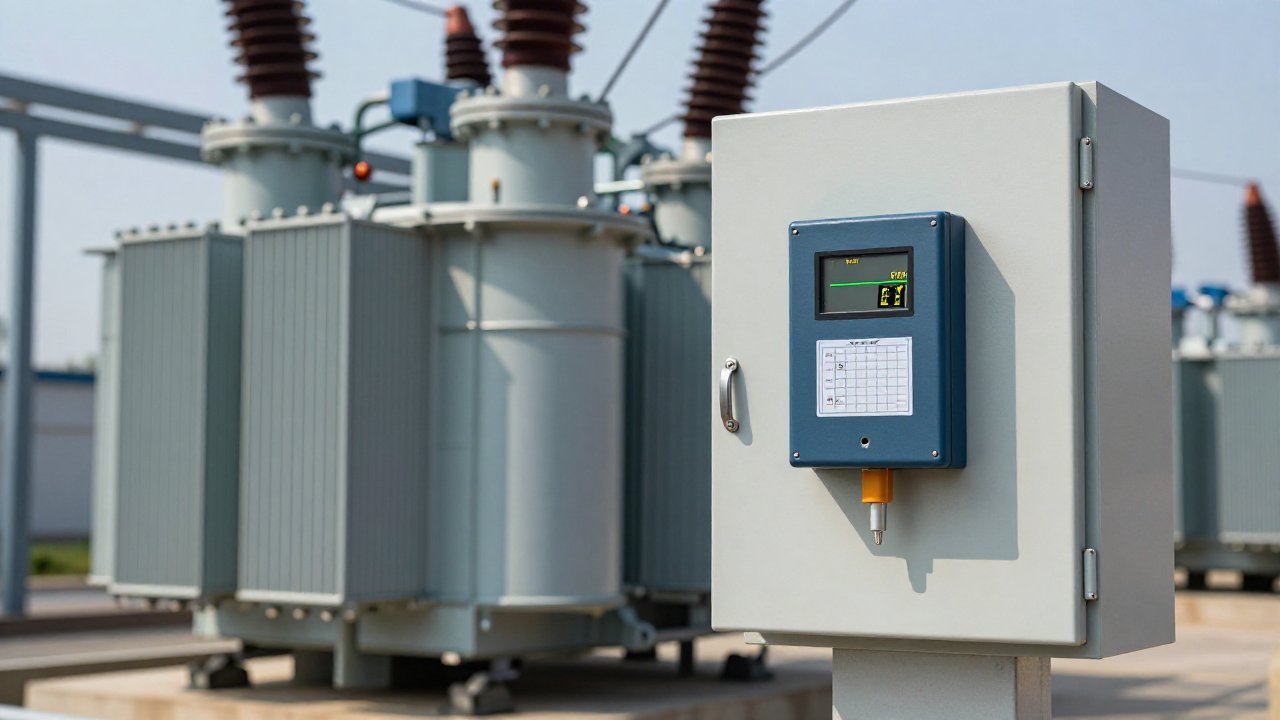
An online dissolved hydrogen sensor mounts directly on the transformer’s drain or sampler valve. A gas-permeable membrane at the tip lets dissolved gas pass from the oil into a small measurement chamber, where a palladium thin-film element reacts selectively with H2 and reports a concentration in parts per million (ppm). Measuring dissolved hydrogen in transformer oil this way needs no carrier gas, no chromatography column, and no periodic cell replacement, keeping operating costs near zero for unattended substations.
The measurement chain matters as much as the sensor itself. A membrane-based cell has a characteristic response time (T63) — the time to reach 63% of a step change in gas concentration — dominated by membrane permeation and cell volume. A well-designed probe balances sensitivity against how quickly it sees a developing fault.
| Fault gas | Typical signal | Comment |
|---|---|---|
| Hydrogen (H2) | Partial discharge, low-temperature overheating | Earliest gas; fastest to diffuse |
| Methane (CH4) | Low-temperature thermal faults | Often rises together with H2 |
| Ethylene (C2H4) | High-temperature overheating | Appears as fault severity grows |
| Acetylene (C2H2) | Arcing, high-energy discharge | Strongest indicator of severe events |
| CO / CO2 | Paper insulation degradation | Signals cellulose aging |
For interpretation, IEEE C57.104 rates transformer condition on a 1–4 scale using multiple dissolved gases and their rates of rise; hydrogen below roughly 100 ppm commonly corresponds to Condition 1, and rising hydrogen shortens the recommended re-test interval. The critical habit is to watch the rate of rise, not just the latest reading — a jump from 20 ppm to 60 ppm in a week means far more than a steady 60 ppm baseline.
From a Reading to a Transformer Health Program
A dissolved hydrogen in transformer oil monitor earns its keep when its readings feed a health program rather than sitting in a silo. That means trending over time, setting staged alarms (advisory, investigation, urgent), and pushing data into substation SCADA or the cloud over MODBUS, IEC 61850, or MQTT. When an alarm fires, the utility pulls the full gas picture — laboratory DGA or a multi-gas online monitor — to type the fault and schedule the repair.
This layered logic is why the new regulatory push requires full-component online coverage for critical assets while hydrogen-only monitoring screens the broader fleet. The two layers are complementary: hydrogen catches the change first; multi-gas explains what it is.
What Is a Normal Dissolved Hydrogen Level in Transformer Oil?
Hydrogen in a healthy, service-aged transformer is usually below about 100 ppm, though the level varies with unit age, design, and oil type — which is why a single reading matters less than the trend.
How fast does an online hydrogen sensor respond to a developing fault? Membrane-based dissolved hydrogen probes respond in minutes to tens of minutes, depending on the T63 of the cell — far faster than a three-to-six-month offline sampling cycle.
Can a Hydrogen-Only Monitor Replace Multi-Gas DGA?
No. Hydrogen is the best single early-warning signal, but fault typing requires the full gas signature. Most programs use hydrogen for screening and multi-gas for confirmation, a trade-off covered in detail in how a hydrogen-only monitor compares with multi-gas DGA.
PAS DGA for Oil Dissolved Hydrogen Monitoring
PAS DGA builds the hydrogen and multi-gas layers utilities need to meet the new monitoring mandate without over-spending: the DGA-500 hydrogen monitor for fleet screening, and the DGA-900 when a unit graduates to full fault typing with nine gases plus moisture. For more on why hydrogen deserves a dedicated layer, see why hydrogen is the first early-warning gas in DGA.
Contact PAS DGA to plan a dissolved hydrogen monitoring layer for your transformer fleet.