
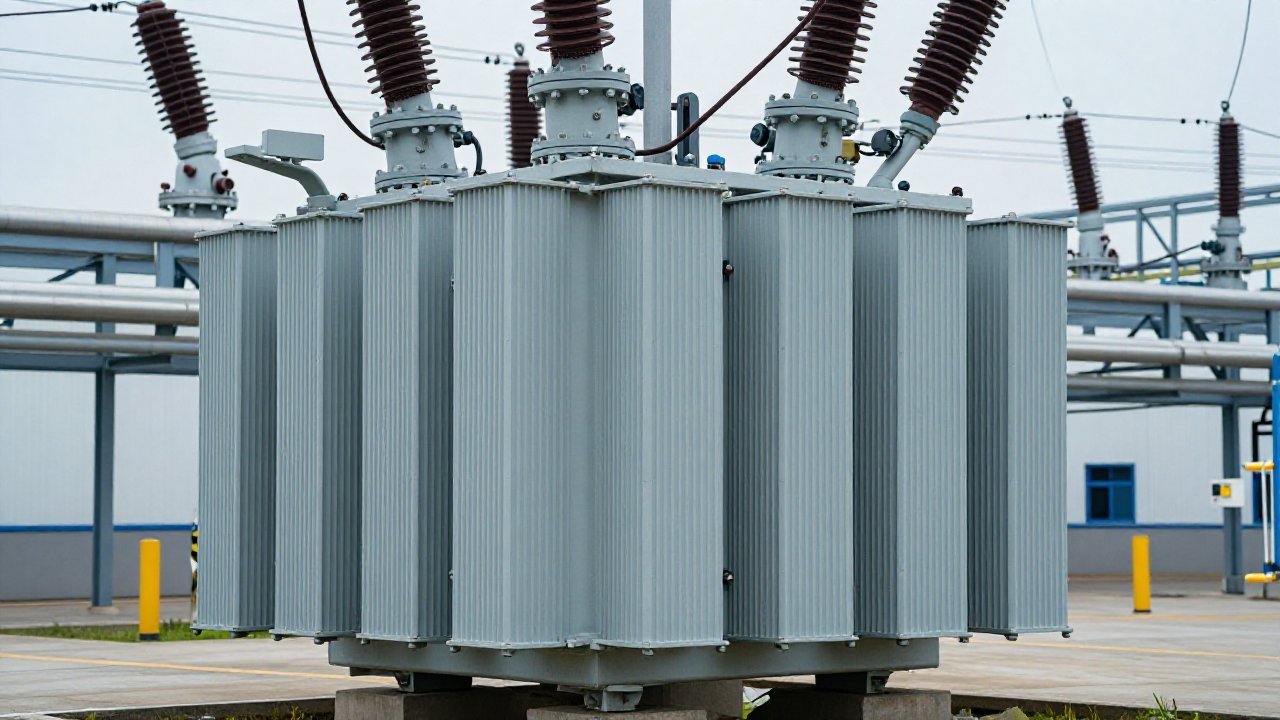
A CIGRE 2026 session paper by Jordan’s Samra Electric Power Company (SEPCO) documents two generator step-up (GSU) transformer failures that were readable in the gas records before a forced trip. In each case the real question was timing: run, repair, or replace. GSU transformer replacement is a long-lead, high-cost decision, and dissolved gas analysis (DGA), with hydrogen the first gas to move, turns an unplanned failure into a scheduled call. This article unpacks both cases and the monitoring plan behind the call.
Two GSU failures, two different gas signatures
The SEPCO paper (reference A2-11893) describes two units at a Jordanian plant. The first, a 139/185 MVA, 132/14.5 kV GSU, showed rising hydrogen, methane, ethane and ethylene. On Duval’s Triangle the combination fell into the T3 zone — a thermal fault above roughly 300 °C. Inspection traced it to a bent tank shunt and sharp metallic edges concentrating magnetic flux and overheating local steel.
The second, a 135/150 MVA generator transformer, failed differently. Its oil carried 119 ppb of 2-furaldehyde (2-FAL) and the paper’s degree of polymerization (DP) was estimated at 466 — roughly 61 percent of paper life remaining. With no nitrogen sealing or working conservator airbag, oxygen and moisture entered the tank; load cycling accelerated cellulose aging.
| Gas marker | What it signals | SEPCO example |
|---|---|---|
| Hydrogen (H2) | Partial discharge, low-energy sparking, early overheating | Case 1: rising with CH4, C2H6, C2H4 |
| Methane + ethane | Low-to-mid temperature thermal activity | Case 1: slow accumulation |
| Ethylene (C2H4) | High-temperature thermal fault (Duval T3) | Case 1: T3 zone |
| 2-FAL + DP | Paper degradation (cellulose aging), not a gas | Case 2: 119 ppb 2-FAL, DP 466 |
Both failures typify an aging GSU fleet: one born in the metalwork, one in the paper.
Hydrogen moves first
Hydrogen forms at lower temperatures than most fault gases: oil overheats from around 150 °C and partial discharge generates it earliest. It is also the most volatile, so it can escape the oil and be missed by a periodic lab sample. That is why continuous hydrogen measurement is the backbone of GSU early warning.
The classic example is a widely cited IEEE case at Mirant’s Morgantown plant. After two earlier GSU failures, an online hydrogen and moisture analyzer was fitted to a 650 MVA unit. Hydrogen climbed from about 500 ppm to 9,500 ppm over four days, acetylene reached 575 ppm, and the triangle pointed to a T3 fault above 700 °C. The monitor caught it while incipient and the unit was repaired instead of destroyed. Published vendor cases tell the same story — an 1,100 MVA GSU whose hydrogen rose from 30 ppm to 277 ppm in two days (vendor data), and a 32 MVA unit where hydrogen near 1,000 ppm preceded a Buchholz trip after 23 years (vendor data).
Timing the gsu transformer replacement decision
The repair-versus-replace logic rests on four factors: fault type, paper condition, age and lead time. A localized thermal fault in the metalwork (Case 1) can often be repaired in a planned outage. A unit with advanced paper aging (Case 2) is harder to justify repairing because the paper sets remaining life. GSU transformer replacement is also a logistics problem: each unit is custom-built and lead times stretch from several months to more than a year. Tennessee’s Old Hickory plant spent two months in ocean shipping alone replacing 1950s-era GSUs in 2022.
That lead time is why online monitoring changes the economics: a fault caught at the hydrogen stage can be managed with controlled loading while a replacement is ordered, turning a forced outage into a scheduled one. The 10-year TCO comparison and the condition-based maintenance guide cover the cost logic; the Duval Triangle guide explains the fault-type mapping.
Building the monitoring plan for a critical GSU
A practical plan starts with hydrogen screening across the fleet — the cheapest sensor that catches the earliest signal. Units with rising hydrogen move to a multi-gas online monitor (acetylene, ethylene, carbon monoxide plus moisture) to classify the fault. Suspect units add 2-FAL and DP checks, feeding a decision gate against IEEE C57.104-2019 Condition 1–4 ratings. The dissolved hydrogen sensor compliance guide is the reference for threshold logic; rate-of-rise analysis explains why the slope beats a single reading. See the hydrogen sensor range and the DGA-900; contact PAS DGA with your fleet size and gas list for a monitoring plan.
How early can DGA catch a GSU problem before failure?
In the published cases DGA gave days to weeks of warning: Mirant’s analyzer flagged escalation over four days, an 1,100 MVA unit moved from 30 ppm to 277 ppm in two days. Hydrogen is the earliest and most volatile gas, so the answer is as early as sensor resolution and sampling interval allow — which is why online monitors beat monthly oil samples.
When should a GSU be replaced instead of repaired?
Consider gsu transformer replacement when the paper is severely aged (DP well below 400 or 2-FAL above roughly 250 ppb), when the fault is active arcing, or when the unit is old and repair would cost a large fraction of replacement. A localized thermal fault in good paper is usually repairable. The decision needs the gas, paper and economic picture — and monitoring that gives you time to gather it.