
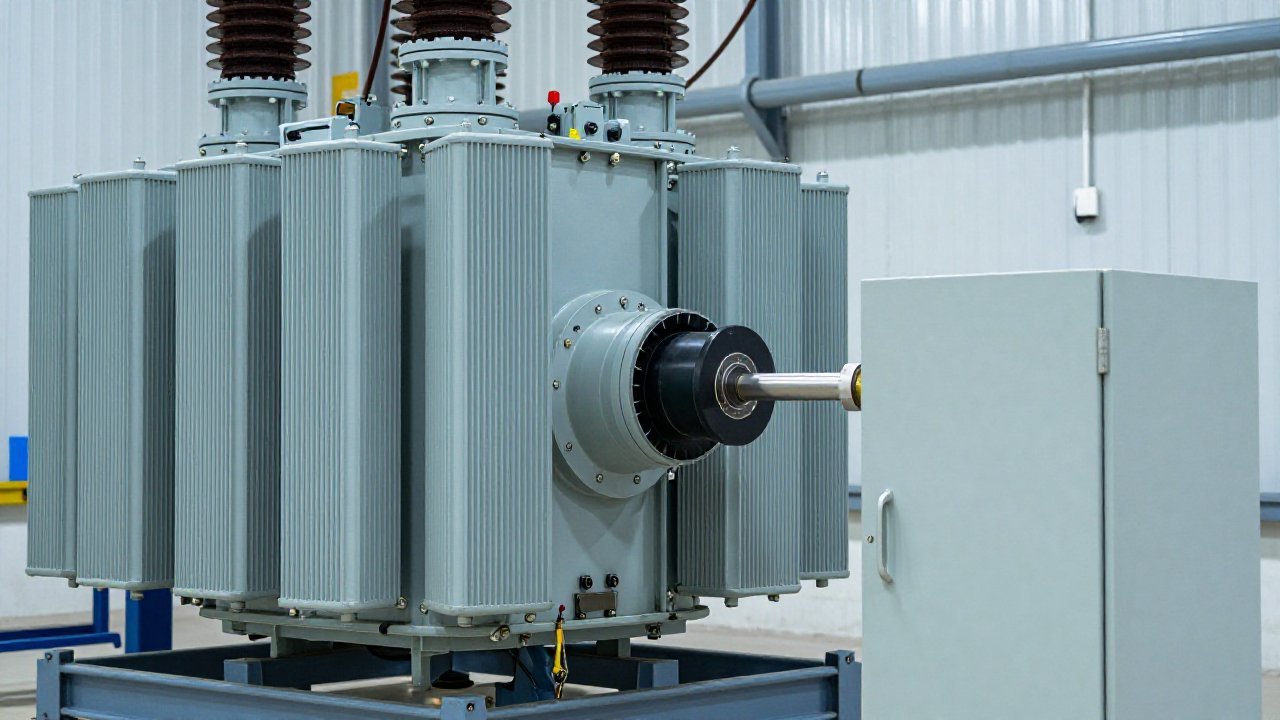
Laser photoacoustic spectroscopy (L-PAS) is the optical measurement method behind a growing share of online dissolved gas analysis (DGA) monitors. It measures dissolved gases directly from a transformer oil sample with zero background signal, no carrier gas, and no consumable columns — while reaching sub-ppm detection limits for the gases that signal developing faults. This article explains the principle in plain terms, the advantages that matter for asset managers, and how L-PAS compares with gas chromatography (GC), NDIR and TDLAS. For the full physics — linewidths, cell designs and lock-in demodulation — see the companion guide on L-PAS physics for engineers.
How laser photoacoustic spectroscopy works
The idea predates DGA by more than a century: Alexander Graham Bell first reported the photoacoustic effect in 1880. A laser is tuned to a wavelength that a target gas molecule absorbs strongly. When the gas absorbs the light, the molecule releases the energy as heat through collisions with neighbouring molecules. Because the laser is modulated — switched on and off at a fixed frequency — the gas heats and cools in a periodic rhythm, generating a tiny pressure wave. A microphone detects that pressure wave, and the signal amplitude is proportional to gas concentration.
Two properties follow directly from the physics. First, the measurement is zero-background: unabsorbed light produces almost no acoustic signal, so a near-zero reading genuinely means near-zero gas — there is no bright transmitted-light baseline to subtract. Second, nothing is consumed: the extracted gas is measured in place and returned, so there is no carrier-gas flow, no calibration-gas cylinder and no column to replace.
The advantages of laser photoacoustic spectroscopy for DGA
| Advantage | What it means in practice |
|---|---|
| No carrier gas or consumables | No gas bottles to swap, no columns to replace — lower lifetime operating cost and fewer site visits. The 10-year TCO comparison for online DGA builds on exactly this. |
| Sub-ppm detection limits | Commercial online L-PAS reaches ≤0.1 ppm for acetylene (vendor-published data) — early enough to catch a developing discharge fault against IEEE C57.104-2019 Condition 1–4 ratings before it escalates. |
| Fully electronic, no moving parts | Laser modulation is electronic rather than mechanical — no chopper, no wear, and better tolerance of substation vibration and outdoor temperature swings (IP55, −40 to +55 °C). |
| Multi-gas coverage in one analyzer | Nine gases plus moisture in a single online monitor — the same instrument that screens hydrogen also tracks acetylene, ethylene and carbon monoxide trends against DGA fundamentals. |
One honest caveat: hydrogen (H2), oxygen (O2) and nitrogen (N2) have no infrared absorption, so commercial L-PAS systems measure them through auxiliary thermal-conductivity channels rather than the optical path. This is a design detail, not a weakness for fault-gas detection — acetylene, ethylene, methane, ethane, CO and CO2 are all measured optically.
L-PAS vs GC, NDIR and TDLAS
| Technology | C2H2 detection limit | Consumables | Typical cycle |
|---|---|---|---|
| Laboratory GC | ppb–sub-ppm | Carrier gas, columns, calibration gas | Hours (offline) |
| L-PAS (online) | ≤0.1 ppm (vendor-published data) | None | Minutes |
| NDIR / FTIR | ppm range | Occasional | Minutes |
| TDLAS | ppm range | None | Minutes |
The trade-off framing matters more than a ranking: laboratory GC remains the reference for absolute accuracy and full oil-test breadth, while online optical methods trade some breadth for continuity. For the full comparison matrix across GC, NDIR, TDLAS, PAS and QEPAS, see DGA sensor technologies compared and the photoacoustic spectroscopy technology guide.
L-PAS in the PAS DGA product line
Laser photoacoustic spectroscopy is the core of the DGA-900, a nine-gas-plus-moisture online monitor engineered for outdoor installation (IP55, −40 to +55 °C) with MODBUS, IEC 61850 and DNP3 communications. For hydrogen-only early warning across a wider fleet, the DGA-500 provides field-standard hydrogen monitoring, and the palladium-nickel sensing mechanism behind it is worth understanding before specifying one. Whether you are protecting a critical power transformer or screening a distribution fleet, the framework in how to select an online DGA monitor applies the same decision logic.
To discuss whether L-PAS fits your transformers, contact PAS DGA with your gas list, detection limits and site conditions.
Is laser photoacoustic spectroscopy the same as photoacoustic spectroscopy?
Photoacoustic spectroscopy (PAS) is the family name for any light-to-heat-to-sound measurement. Laser photoacoustic spectroscopy (L-PAS) is the specific variant that uses a narrow-linewidth laser as the light source instead of a broadband IR lamp with optical filters. The laser’s linewidth — on the order of 15 fm — lets each gas be excited on its own absorption line with minimal cross-interference.
Does an L-PAS DGA monitor need carrier gas or calibration gas?
No. The oil sample is degassed and the extracted gas is measured in place and returned; there is no carrier-gas flow and no consumable column. Routine verification relies on internal standards rather than field gas cylinders, which is one reason online L-PAS monitors are practical for unmanned and remote substations.