
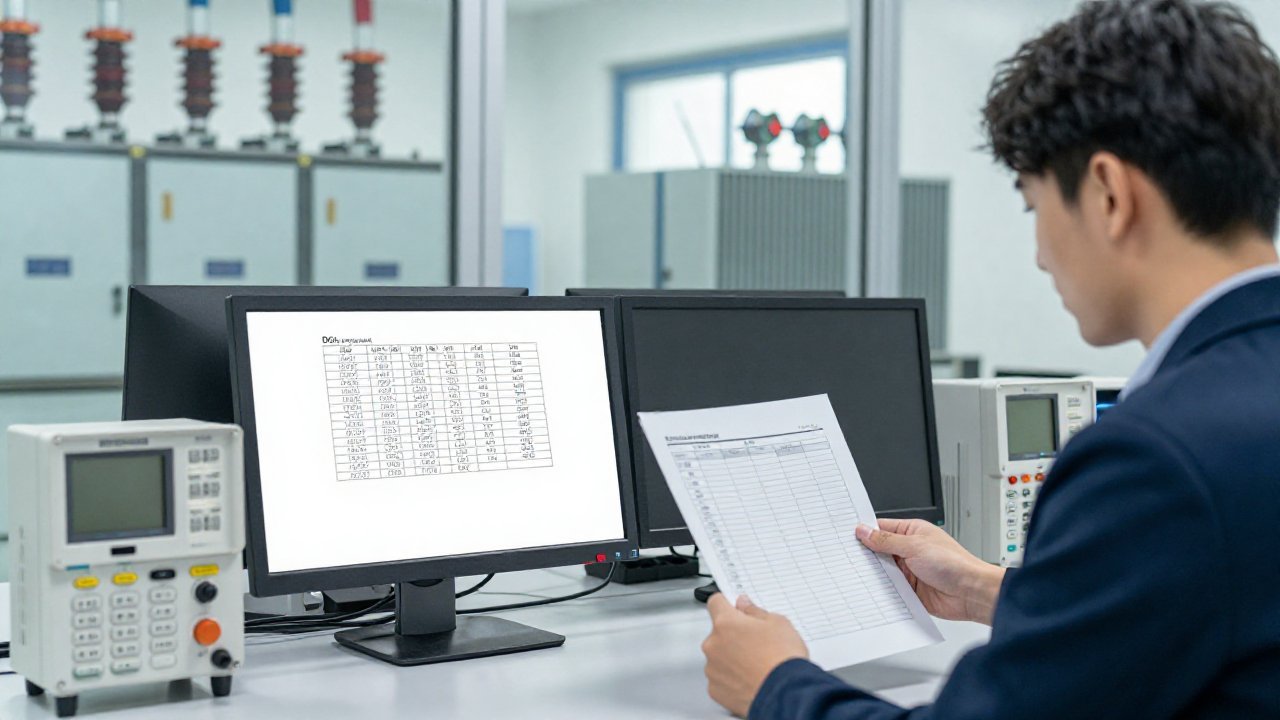
The dga monitor price question is usually the first one a utility buyer asks, and it is the hardest to answer from a spec sheet. Procurement records from 2026 show how wide the gap really is: Chinese grid operators awarded online DGA retrofits at roughly $16,000 to $21,000 per transformer (converted values from July 2026 tender awards), while a nine-gas portable chromatograph shipped from China to Peru in January 2024 with a customs-declared unit value of $13,147. A Western-brand nine-gas monitor can list at $36,000 or more through regional dealers. This guide turns those real price points into a practical dga monitor price map for online, portable and hydrogen-only monitoring.
The DGA monitor price range in 2026
Prices cluster into four segments. The figures below combine export customs records (HS 9027), utility tender awards and current B2B marketplace listings; treat them as planning ranges, not binding quotes.
| Segment | Gas coverage | Typical range (USD) | Evidence behind the range |
|---|---|---|---|
| Online multi-gas (PAS or GC, 7-9 gases + moisture) | Full fault-gas fingerprint | $10,000-45,000 | $13,147 customs export record; $14,990-16,000 marketplace listings; $16-21k utility tender awards |
| Online multi-gas (Western brand) | Full fingerprint | $35,000-100,000+ | Dealer listing $36k (nine-gas class); $96k with add-on modules |
| Online hydrogen sensor | H2, some H2+CO | $2,000-14,000 | About $1,000 for a transmitter module (surplus listing); $5,500-9,000 for new OEM units |
| Portable / offline analyzer | 1-9 gases per sample | $4,000-20,000 | Marketplace listings $7,000-16,000; lab GC from $9,600 FOB |
These are planning ranges, not market averages. Where a number comes from a single customs record or a single dealer listing, treat it as indicative of one real transaction rather than a consensus price. Online multi-gas systems form the bulk of the market and the widest price spread. The low end buys a compact seven-gas GC with a basic valve package; the high end buys a nine-gas laser photoacoustic (PAS) monitor with no consumables, moisture measurement and IEC 61850 or Modbus integration. International-brand units sit above most Chinese exports partly because of distribution margin and partly because of specification differences.
Why online DGA monitor prices vary so much
Four variables move the number more than brand markup does:
- Gas count and detection limit. A hydrogen-only unit is cheap; a monitor that resolves acetylene below 0.1 ppm needs a more sensitive optical or chromatographic core.
- Technology and consumables. Gas-chromatography (GC) designs need carrier gas and column replacements over the product life; PAS and solid-state designs remove that recurring cost, which changes the ten-year ownership math even when list prices look similar.
- Communication and integration. DNP3, IEC 61850, Modbus TCP and fleet software add capability and price.
- Scope of supply. Marketplace “system” prices sometimes cover only the analyzer module, while utility tenders bundle mounting, commissioning, training and warranty.
That is why two quotes for the same gas count can differ by a factor of three, and why a careful buyer compares total cost of ownership rather than the headline number.
Portable and offline DGA analyzers: a lower entry price
Portable chromatographs remain the most price-transparent category because dozens of manufacturers compete on marketplaces. Chinese portable nine-gas units typically list between $7,000 and $16,000, with verified samples at $13,500 and $15,000-16,000, and a desktop laboratory GC for oil testing can be had around $9,600-16,000 FOB. Lab-based testing is cheaper still at $100-500 per sample, but it returns data weeks after the sample is drawn, which is precisely the gap an online monitor closes.
What does a DGA monitor price actually include?
Before comparing quotes, confirm whether the number covers the analyzer only or the full installed system: oil-loop accessories and valves, mounting and commissioning, a first calibration, remote communication setup, warranty length, and delivery terms. Under HS 9027, gas analyzers, photoacoustic instruments and chromatography equipment can carry different import-duty treatments, so a quoted FOB price may not be the landed cost your project budget should use.
Are cheap DGA monitors from B2B marketplaces reliable?
Low listings are not automatically low quality, but they deserve extra scrutiny. Many “systems” under $10,000 are analyzer modules or stripped configurations; real project deliveries with commissioning land higher. Check the detection-limit specification against the fault gases you care about, acetylene especially, confirm the consumables policy, and ask for a reference installation. The customs and tender data above show that credible Chinese exporters transact in the $13,000-21,000 range for a full multi-gas online unit, which is a more realistic planning number than a $3,000 teaser listing.
PAS DGA: quoted prices with zero-consumable running costs
PAS DGA publishes project quotes rather than shelf prices, and the value case rests on the ten-year cost, not the first invoice. The DGA-200, DGA-300 and DGA-500 hydrogen monitors and OEM probes give a low-cost screening tier for distribution fleets, while the nine-gas DGA-900 delivers the full fingerprint for critical transformers with no carrier gas and no column maintenance. Whether a zero-consumable monitor justifies its premium depends on fleet size and asset criticality; the ten-year comparison is the right lens. Contact PAS DGA for a configuration-specific quote.