
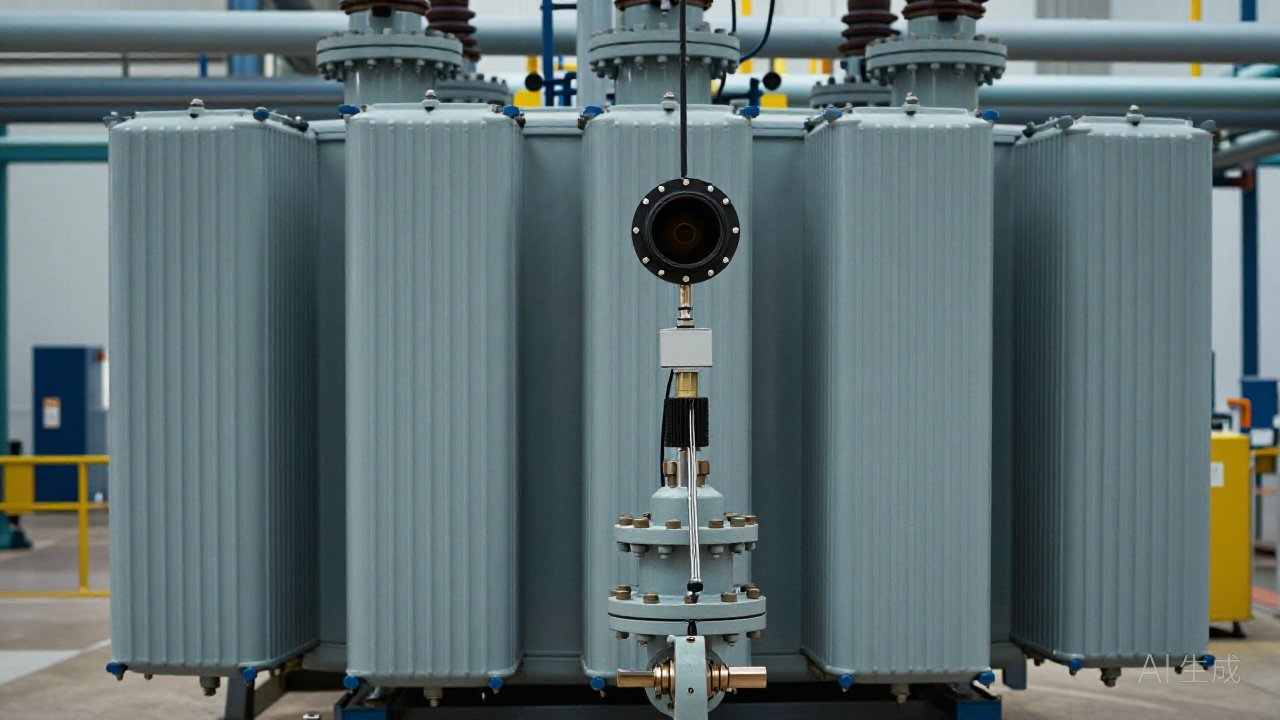
The question used to be answered by habit: one oil sample a year, usually in the same month. In October 2026 Megger put online hydrogen, acetylene and moisture measurement into a single substation monitor and positioned it, in vendor material, as a complement to periodic laboratory DGA rather than a replacement. That framing moves the argument. If laboratory testing stays, then offline DGA sampling frequency is no longer an administrative detail; it is the number that sets how long a fault can develop before anyone sees it.
The blind window is the thing you are choosing
Between two samples, the transformer is unobserved. The gap is not neutral. A fault that generates gas slowly will still be caught by an annual test; a fault that generates it quickly will not be caught at all, because the first evidence arrives when the gas is already at a level that changes the operating decision.
A simple calculation makes the trade visible. If a developing thermal fault raises dissolved hydrogen by 5 ppm per day, an annual interval allows 1,800 ppm to accumulate between readings. No interpretation guide is needed at that point; the early-warning value of the test has already been spent.
Rate of rise, not the absolute value, sets the floor
Dissolved gas analysis (DGA) interpretation has moved toward rate-based judgement for exactly this reason. A single number is compared against a table; a pair of numbers yields a slope, and the slope is what separates a stable old unit from one that is failing now. The rate-based approach is described in DGA trend analysis and rate of rise.
Two samples are the minimum for a slope, which means the sampling interval also fixes the earliest moment a rate can be computed. Quarterly sampling gives a rate estimate every three months; annual sampling gives one per year. Where a fast fault is plausible, the interval is not chosen to save money on analysis, it is chosen to keep the rate estimate meaningful.
Two events reset the clock. After oil treatment or degassing the gas inventory is artificially low, so the next sample needs to come early rather than on schedule. After a through-fault, a tap-changer operation under fault, or any alarm, a sample belongs in the same week, not in the next cycle.
A three-tier interval that survives audit
Uniform intervals are easy to write and easy to defend until someone asks why a 40-year-old generator step-up transformer gets the same attention as a lightly loaded distribution unit. A tiered program answers that question in advance.
| Tier | Population | Routine interval | Extra trigger |
|---|---|---|---|
| Critical | GSU and single-transformer substations, heavy duty, DGA history | Quarterly | Any rate increase, through-fault, oil work |
| Important | Main transformers with backup capacity | Semi-annual | Gas level change, load growth |
| Normal | Distribution and spare-capacity units | Annual | Post-fault, post-maintenance |
The override matters more than the table: any unit whose gas rate crosses a condition boundary moves up one tier immediately, regardless of its nameplate or age. That single rule prevents the common failure mode where a transformer stays on an annual cycle because nobody owns the decision to change it.
When continuous monitoring is cheaper than the interval
Sampling has a real unit cost: the visit, the safe work permit, the syringe and shipping, the laboratory charge. Multiplied by four visits a year and a fleet of thirty critical units, the annual figure is large enough to be compared against hardware. The comparison is not like for like, however. A hydrogen sensor watches one gas, plus moisture in some models; it does not replace the furan, moisture and particle tests that a laboratory sample carries.
The workable split is hybrid. Continuous hydrogen monitoring goes to the tier-1 units and to the ones already showing activity, and the laboratory program continues across the whole fleet at the interval the tiers justify. The hydrogen sensor range covers the first role; the DGA-500 adds gas separation for multi-gas monitoring where the fault type matters as much as the alarm.
Cost per sample and monitor pricing both vary widely by region and scope; the figures used in planning are best taken from a current DGA monitor price guide and a laboratory quotation, not from a rule of thumb.
What is a reasonable offline DGA sampling frequency for an ageing transformer?
Quarterly while it is in the critical tier, and semi-annual once its rate has been flat for several cycles. Age alone does not justify a shorter interval; activity in the gas record does.
Can online hydrogen monitoring replace periodic oil sampling?
No. It replaces the waiting between samples for one gas, which is where most early faults announce themselves. Moisture, furans, acidity and particles still require a laboratory sample, and the physical sample remains the reference method.
Sampling procedure and interval are separate controls, and the first is well covered in transformer oil sampling best practices and the wider online versus offline monitoring comparison. Where the program has to be written down for a regulator or an insurer, the evidence chain is easier to assemble if the interval rule is stated before the first result arrives. The hydrogen monitoring hub collects the design and compliance side of that case at dissolved hydrogen sensor compliance. To size an interval or a sensor count for a specific fleet, send the asset list through the contact form.