
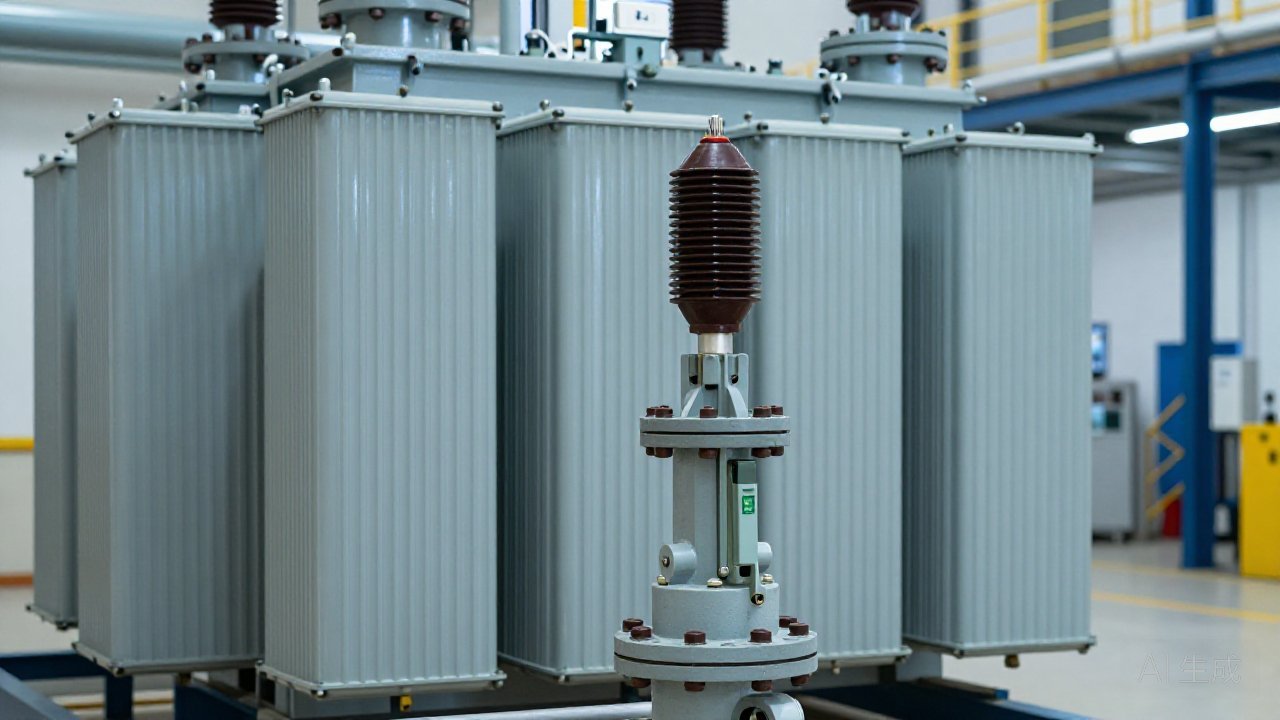
A continuous gas monitor reports hydrogen climbing for three days. The next laboratory sample, drawn from the same transformer, comes back inside the normal band. Someone has to decide which reading goes into the maintenance decision, and the answer is rarely “the laboratory, because it is more accurate.” In an October 2026 commentary a hydrogen sensor manufacturer argued that annual testing leaves operators blind between samples. The counter-argument is just as real: a laboratory result is a calibrated measurement of a defined sample. Reconciling offline DGA results with a continuous reading is a sampling and timing problem before it is an instrument problem.
Why two readings of the same oil diverge
Oil in a power transformer is not a stirred tank. Temperature stratifies it, flow paths concentrate gas near the coolers, and the tap-changer compartment holds its own oil. Each sampling point therefore sees a different mixture. A monitor fed from a valve on one side of the tank and a syringe drawn from another are not measuring the same oil, even when both are working correctly.
Timing adds a second dimension. Gas dissolves into oil over hours and diffuses through a membrane more slowly still, so a monitor’s reading lags the oil it samples. A laboratory sample is a snapshot of one moment in that same lagging process.
Where the disagreement usually starts
Before blaming either instrument for a mismatch between offline DGA results and the monitor, walk the sampling chain. In utility practice six causes account for most conflicts.
| Source | Effect on the reading | How to rule it out |
|---|---|---|
| Different sampling points | Different oil, different gas fraction | Draw the reference sample from the monitor’s own tapping |
| Oil temperature at sampling | Solubility and partitioning shift with temperature | Record top-oil temperature with every sample |
| Air ingress in the syringe | Dilutes the sample, adds nitrogen and oxygen | Check N₂/O₂ against the 3.7:1 air signature |
| Delay before analysis | Light gases migrate through the syringe wall | Analyse within the holding time of the method |
| Monitor membrane lag | Reading trails the oil by minutes to hours | Compare same-hour trends, not one instant |
| Calibration drift | Offset accumulates quietly | Challenge the monitor with a known gas standard |
The sampling chain is where most false alarms are manufactured; the failure modes are set out in transformer oil sampling best practices.
The monitor side: lag, temperature and drift
A dissolved hydrogen sensor responds to the partial pressure of hydrogen at its membrane. Vendor data for the DGA-300 probe quotes a 2 to 2,000 ppm range and a t90 under 30 minutes in oil above 100 ppm; the DGA-500 extends the range to 5 to 5,000 ppm (vendor data). Both figures describe a step change in a laboratory, not the slow ramp a real fault produces. On a ramp the displayed value trails the oil by a margin that grows with the rate of change, which is why a monitor and a lab sample taken at the same minute can legitimately differ.
Calibration drift is the quieter source. A monitor that has run for years without a gas challenge still produces a smooth, plausible trend, and a smooth trend is exactly what an operator trusts. A single-point check against a certified standard settles more arguments than any amount of discussion.
How to arbitrate offline DGA results
- Compare like with like. Put the laboratory result beside the monitor’s rolling average over the same window, not beside the instantaneous display.
- Re-sample from the monitor’s tapping. If the repeat sample moves toward the monitor, the first sample was the outlier; if it does not, the monitor needs a challenge.
- Read the direction, not the level. A monitor that is consistently high but tracks every change is usable for trending. A monitor whose readings stopped moving is suspect regardless of absolute agreement.
Arbitrating offline DGA results against a trend only works if both records carry the same context: time, sampling point, load, top-oil temperature, and the instrument that produced the number. Where oil treatment or degassing has taken place, both instruments are also reading a reservoir still refilling from the paper, as described in DGA after oil treatment.
Should a laboratory result override a monitor alarm?
No single result overrides a trend. Confirm with a repeat sample drawn from the monitor’s own tapping, and treat a monitor that has stopped responding to gas changes as the more urgent problem.
How often should the monitor be checked against a gas standard?
Align the check with the annual laboratory programme so both records can be compared on the same day, and repeat it after any repair, oil treatment or sensor replacement.
Both instruments belong on one oil system, and the value comes from keeping them comparable. A sensor on the same tapping as the sampling valve, paired with a multi-gas monitor when the full seven-gas picture is needed, removes most of the divergence at source. The hydrogen sensor range covers continuous single-gas monitoring, the DGM-900 adds the multi-gas and moisture view, and the wider framework sits in dissolved hydrogen sensor compliance and online versus offline DGA. Record templates are collected under manuals and resources. To review a specific conflict on your fleet, send the paired records through the contact form.