
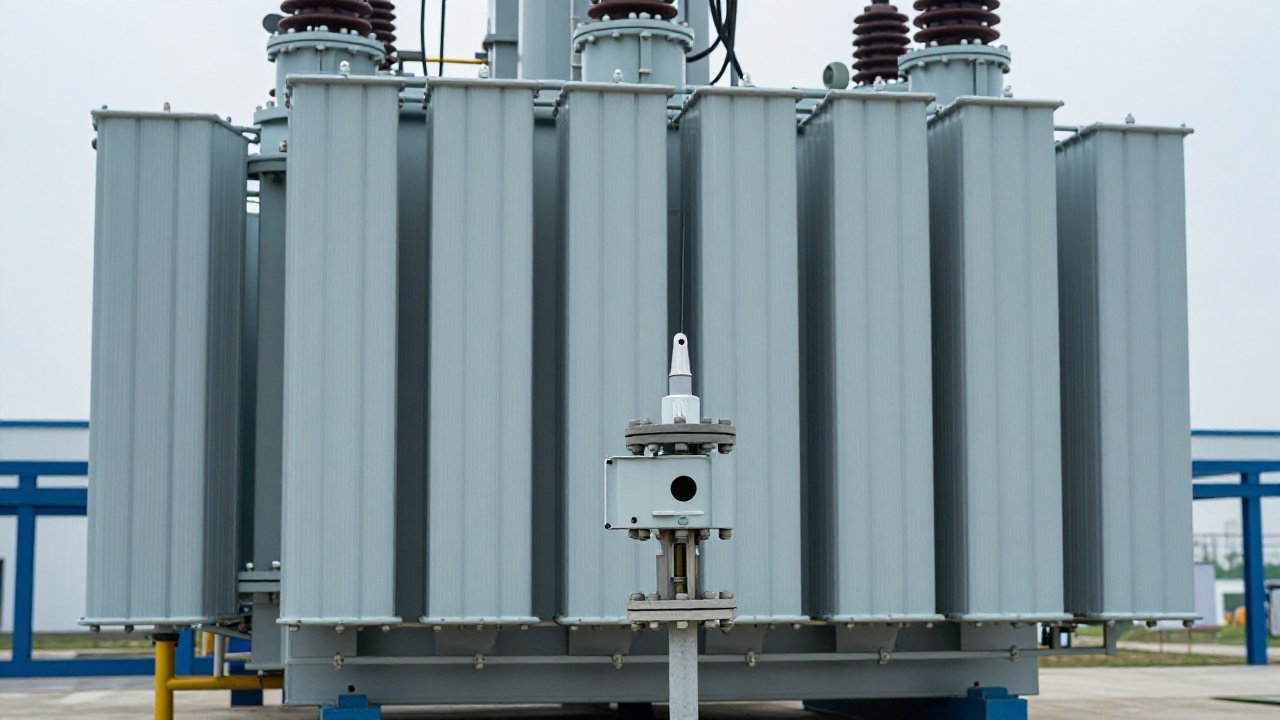
On 21 August 2026 Qualitrol confirmed it is roughly doubling capacity at its Fairport, New York plant, and the reason it gave was a grid moving from periodic inspection to continuous condition monitoring. That shift sounds like a hardware story, but the harder half is procedural. Online dissolved gas analysis (DGA) only changes maintenance when a reading can trigger an action, and choosing that trigger is where condition-based maintenance for transformers is usually won or lost.
A monitor that reports every hour but never raises an alarm has added data, not warning. A monitor that raises an alarm on every small drift adds work orders nobody closes. Both failures trace back to the same missing piece: a defined trigger condition, and a baseline the trigger is measured against.
Why the First Trigger Is the Hard Part
Most transformer faults produce hydrogen first. Overheating, partial discharge and arcing liberate hydrogen before the higher hydrocarbons build up to anything a multi-gas table would notice, which is why a single-gas hydrogen channel is the usual early-warning element (hydrogen as a leading gas). The same property makes hydrogen noisy: temperature swing, load swing and a recent oil top-up all move the number, so a trigger written as a fixed concentration either sits above the noise and arrives late, or below it and never stops.
Three Signals, Three Failure Modes
| Trigger type | How it is written | How it fails |
|---|---|---|
| Absolute threshold | A fixed concentration, for example a Condition band from IEEE C57.104-2019 or a limit from IEC 60599:2022 | Late on slow faults; deaf to a unit that starts high and stays there |
| Rate of rise | A change per unit time, for example µL/L per day | Rules on two noisy samples; trips on a sampling artefact |
| Departure from baseline | A multiple of the unit’s own steady-state level and spread | Useless until a baseline exists — and wrong if load or temperature moves with the gas |
None of the three is sufficient alone, so mature schemes run them in series: baseline departure to notice, rate of rise to confirm movement, and an absolute band to say how serious it has become. Severity itself still comes from the standard tables, and the interpretation path is set out in Duval triangle guidance.
Building the Baseline a Trigger Compares Against
The baseline is the quiet part of condition-based maintenance for transformers, and the part most often skipped. It is not the first reading; it is the distribution of readings a healthy unit produces across its load and temperature cycle — which means a settling window after commissioning, an oil change and any repair that lets air into the tank. Load and top-oil temperature are recorded alongside the gas value, because a channel that tracks loading otherwise looks like a fault every afternoon.
The payoff is that the baseline is portable across units in judgement but not in numbers. Two identical transformers hold different steady-state hydrogen levels, so a fleet-wide table of absolute trigger values produces false alarms on clean units and silence on dirty ones.
What Should Trigger Condition-Based Maintenance for Transformers?
A trigger worth wiring to a work order has three parts: a condition, a confirmation, and an owner. The condition is a departure from the unit’s own baseline; the confirmation is a second signal, either a rising trend over the measurement cycle or a matching change on another gas; the owner is the person the alarm reaches. Without the confirmation step, hydrogen noise becomes alarm fatigue. Without a named owner, it becomes a log entry. Comparing continuous and laboratory readings is covered in online versus offline DGA, and the wider programme the trigger feeds into is described under condition-based transformer maintenance.
Does Continuous Monitoring Replace the Oil Sampling Programme?
No, and a trigger condition should say so explicitly. Continuous monitoring supplies the timing and the trend; laboratory DGA supplies the reference on a recognised method under IEC 60567, and IEC 60599:2022 and IEEE C57.104-2019 judge a result. A robust trigger therefore escalates to a confirmation sample rather than to an immediate outage, which is how fleet-scale schemes keep the programme affordable (DGA monitoring for transformer fleets).
PAS DGA for a Trigger That Reaches a Work Order
An early-warning channel only works if the sensor holds its calibration between visits. The hydrogen sensor family places a palladium alloy element directly in the oil, with no membrane, no oil-to-gas path and no reference gas to re-calibrate; the elements are covered by dissolved hydrogen sensor compliance (vendor data). Where a fault type has to be named rather than merely detected, DGA-900 adds nine gases plus moisture on the same installation. Send us the unit ratings, the loading profile and the sampling interval, and we will return a trigger scheme with the baseline window and escalations written in — contact PAS DGA.
Sources
- Qualitrol press report, 21 August 2026: expansion of the Fairport, New York plant, citing a shift from periodic inspection to continuous condition monitoring.
- IEEE Std C57.104-2019, Guide for the Interpretation of Gases Generated in Mineral Oil-Immersed Transformers, Condition 1–4 ratings.
- IEC 60599:2022, mineral oil-immersed electrical equipment in service — interpretation of dissolved and free gases; IEC 60567, sampling of gases and of oil.
- PAS DGA hydrogen sensor product data, DGA-300 and DGA-500 palladium alloy elements, direct oil immersion (vendor data), accessed 1 October 2026.