
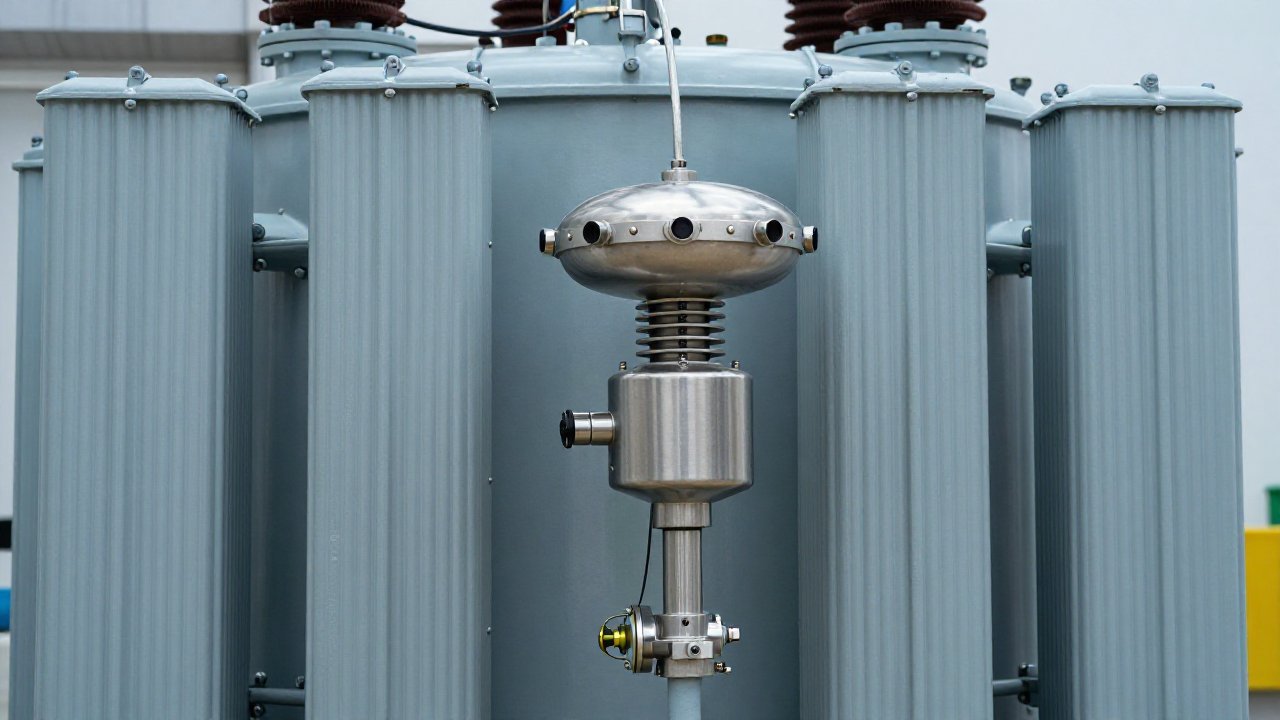
A 2026 study in Applied Thermal Engineering modelled how acetylene (C2H2) spreads through the oil of a converter transformer and found it spreads unevenly. Between the point where gas is generated and a fixed sampling tap on the tank sidewall, the simulated dilution ratio fell as low as 0.0143%; at a 0.3 µL/L trigger threshold, only 22.67% to 82.89% of the injected acetylene reached the tap across four operating scenarios. The lesson generalises to every large oil-immersed transformer: installing online DGA monitoring systems without deciding where the oil comes from is how a monitor spends its life watching an empty corner of a tank.
Dissolved gas analysis (DGA) reads a sample of oil, not an average of the tank. Faults generate gas locally, and the oil carries it away along whatever path the pumps and thermal gradients set up — so a monitor drawing from the main tank valve sees the bulk oil, while one drawing from a dead corner sees it later, or never.
Two Decisions That Set What a Monitor Can See
| Decision | Question it answers | Failure mode when it is wrong |
|---|---|---|
| Sampling point | Does the oil reaching the analyser pass the fault zone? | Blind spots and delayed detection |
| Circulation path | Is the sample representative of the oil volume that matters? | A reading that lags the defect by hours |
| Measurement cycle | Can the trend resolve a fast acetylene rise? | An event that starts and ends between readings |
| Attention threshold | Does a trace reading raise alarm or get ignored? | A first alert that arrives after the damage |
The 2026 modelling study tested the first row directly. Its authors designed three optimised monitoring-point layouts and reported that the probability of triggering a 0.3 µL/L acetylene threshold rose from 42.5% under the conventional fixed-point arrangement to 82.5%, 72.5% and 90%, depending on layout. Nothing about the gas changed; only the position of the tap did. Two identical monitors on two identical transformers can therefore report different numbers for the same fault, which is why trend comparison belongs to the unit’s own history rather than a fleet-wide table (DGA fundamentals).
What Changed in How Utilities Buy These Systems
The installation side has moved as well. A transformer-monitoring tender from Thailand’s Metropolitan Electricity Authority requires continuous measurement of at least eight gases, through acetylene, and support for IEC 61850 over copper or fibre; a 2026 Indian substation tender routes the same data to the substation automation system over a fibre-optic port. The common thread is that a monitor is now expected to behave like an intelligent electronic device on the station bus, not a stand-alone logger.
Running cost has moved with it. The monitors marketed for renewal duty in 2026 are, almost without exception, sold as carrier-gas-free — GE’s HYDRAN M2-X, Vaisala’s OPT100, GE Vernova’s Transfix DGA 500 and Doble’s Calisto R9 all avoid carrier or calibration gas consumables in their published specifications (vendor data). For a unit already carrying a 2015-era oil-chromatography monitor, the replacement decision is less about detection limits than about what the site must keep stocking and calibrating.
Where should the oil sampling point be on a large transformer?
There is no single answer, because the right point follows the oil’s circulation path rather than the tank geometry. The practical principle is to draw from a point inside the main convective flow, downstream of where faults typically develop, and to keep it fixed across the unit’s life so its trend stays comparable. Where circulation is strongly forced, the 2026 result — that layout alone can double the chance of catching a sub-ppm acetylene trace — argues for validating the point against a laboratory sample before the monitor is trusted.
Does an online DGA monitoring system replace laboratory DGA?
No. Continuous monitoring supplies the trend and the timing; the laboratory supplies the reference on a recognised method under IEC 60567, and IEC 60599:2022 and IEEE C57.104-2019 are the documents both sides use to judge a result. That division of labour is why online DGA monitoring systems are specified alongside a sampling programme rather than instead of one. The comparison between the two is covered in online versus offline DGA, and the fleet-level architecture in DGA monitoring for transformer fleets.
PAS DGA for Continuous Monitoring That Sees the Fault
The instrument matters less than where the oil comes from, but online DGA monitoring systems still have to survive the site. The DGA-500 hydrogen monitor covers 5 to 5,000 ppm with a 5 ppm detection limit over −40 to 105 °C, and the DGA-300 probe covers 2 to 2,000 ppm at ±20% or ±2 ppm; both place a palladium alloy element directly in the oil, with no membrane and no oil-to-gas path (vendor data). At the top of the range, DGA-900 adds the full nine gases plus moisture for units where a fault type has to be named rather than merely detected. The hydrogen sensor family covers standalone and OEM duty, and the compliance basis for the sensing element itself is in dissolved hydrogen sensor compliance. Keeping the resulting trend readable to operations is what DGA monitoring software has to do. Send us the unit ratings, the oil-circuit drawing and the existing sampling points, and we will return an installation proposal — contact PAS DGA.
Sources
- “Study on heterogeneous diffusion of fault gas in converter transformer driven by thermal-fluid coupled field and optimization of monitoring points layout,” Applied Thermal Engineering (ScienceDirect), 2026. Dilution ratio 0.0143%–0.353%; acetylene volume ratios 22.67% / 82.89% / 24.26% / 23.24% at a 0.3 µL/L threshold; optimised layouts raise trigger probability from 42.5% to 82.5% / 72.5% / 90%.
- Metropolitan Electricity Authority (Thailand), power transformer monitoring system tender specification: continuous measurement of at least eight gases and IEC 61850 over LAN or fibre, with an IEC 61850 conformance test certificate (tender document).
- Substation automation tender document, India, January 2026: transformer accessory data transferred to the substation automation system per IEC 61850 over a fibre-optic port (tender document).
- Manufacturer specifications for GE HYDRAN M2-X, Vaisala OPT100, GE Vernova Transfix DGA 500 and Doble Calisto R9 — carrier- and calibration-gas-free operation (vendor data), accessed 29 September 2026.
- IEC 60599:2022 (fault types); IEC 60567 (sampling and gas extraction); IEEE Std C57.104-2019 (Condition 1–4 ratings); IEC 61850 (station bus).
- PAS DGA hydrogen sensor product data, DGA-300 and DGA-500 (vendor data), 29 September 2026.